

After languishing for years, the sportbike market has made a comeback. The segment has seen double-digit growth since 2022. Sales have been particularly brisk for 501-750cc bikes, with annual growth exceeding 20% over the past couple of years. Right in the heart of that weight class is the Yamaha YZF-R7.
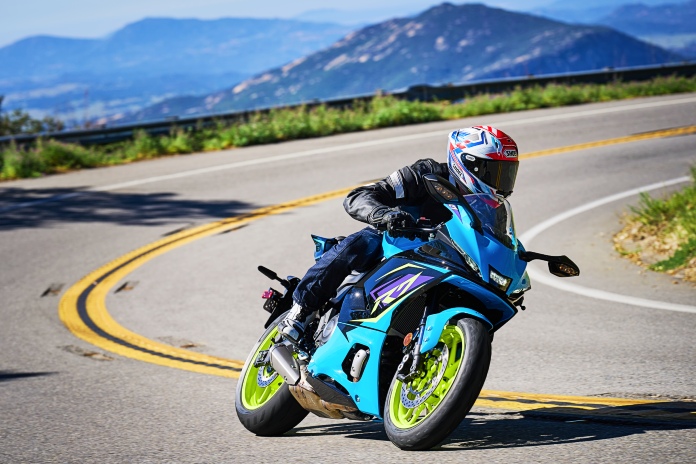
Launched for the 2022 model year, the R7 cracked the sportbike code by offering the supersport styling riders want, a level of performance they can handle, and a price they can afford. It quickly became Yamaha’s top-selling motorcycle of any size or segment.
Then the Great Recession came along. Motorcycle sales tanked and the sportbike wars ended abruptly. Easy money became a thing of the past, and affordability became a higher priority. Small sportbikes, like the Yamaha YZF-R3 that debuted for 2015, became the popular choice.
During the sportbike wars of the late 1990s and early 2000s, the Japanese Big Four updated their 600cc and 1,000cc sportbikes every couple of years. Most were track-oriented machines with high-rpm inline 4-cylinder engines. As they became more powerful and sophisticated, they also became more expensive.
Manufacturers also focused on modularity, using a single engine across multiple model platforms. Yamaha’s FZ-07 (which became the MT-07), also introduced for 2015, was a naked sportbike powered by a versatile 689cc parallel-Twin with a 270-degree crank. That same engine was then used in the XSR700 retro roadster (launched for 2018) and the Ténéré 700 adventure bike (launched for 2021).
The YZF-R7, built around the same 689cc CP2 engine, arrived for 2022 with a price of just $8,999. That same year the YZF-R6, which cost $12,199, was discontinued. With the R7, a middleweight supersport was again within reach of younger buyers. Yamaha says that since the R7 joined the lineup, the number of first-time buyers doubled, and the median age of R-series customers dropped from 33 to 27.
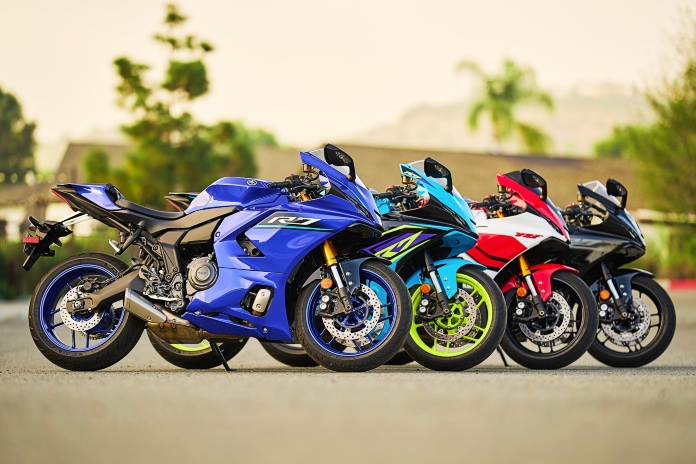
Four years on, Yamaha’s best-selling bike needed a refresh. Updates to the 2026 YZF-R7 focused on handling, ergonomics, technology, and styling.
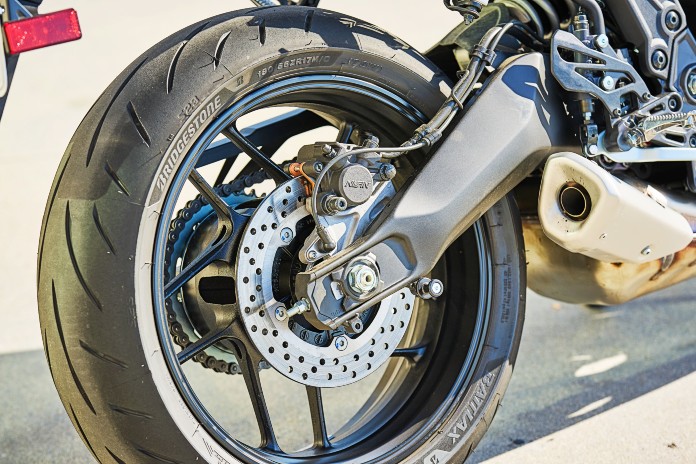
To improve the R7’s handling, its tubular-steel frame and cast-aluminum swingarm were redesigned for more rigidity; its KYB 41mm inverted fork was given lighter aluminum rods (saving 0.75 lb) and revised damping; its wheels were made using Yamaha’s proprietary spin-forging process (saving more weight) and shod with Bridgestone’s latest Battlax Hypersport S23 tires; and its bodywork was revised to be more aerodynamic.
GEAR UP
- Helmet: Shoei X-Fifteen
- Jacket: Cortech Revo Leather
- Airbag Vest: Alpinestars Tech-Air 5 Plasma
- Gloves: Cortech Revo ST V2
- Pants: Cortech AA Dyneema Jeans
- Boots: Cortech Sport Lite
Since most R7s will spend a majority of their time on the street, the riding position was revised for more comfort while still maintaining an active stance. The clip-on handlebars were made wider and moved up and closer to the rider. The seat is a tad lower, has a flatter angle, and is covered with a grippier material. The fuel tank is shorter where it meets the seat and has deeper knee cut-outs (capacity also increased by 0.3 gallon).
Tech-wise, the R7 has taken a huge leap forward. It’s now equipped with throttle-by-wire and a 6-axis IMU, enabling the Yamaha Ride Control electronics suite. There are four normal ride modes (Sport, Street, Rain, and Custom) and four customizable track modes (which allow rear ABS and wheelie control to be disabled). Rider aids include cornering ABS, cornering traction control, slide control, wheelie control, launch control, engine brake management, and back slip regulator. An up/down quickshifter, cruise control, and variable speed limiter are also standard.
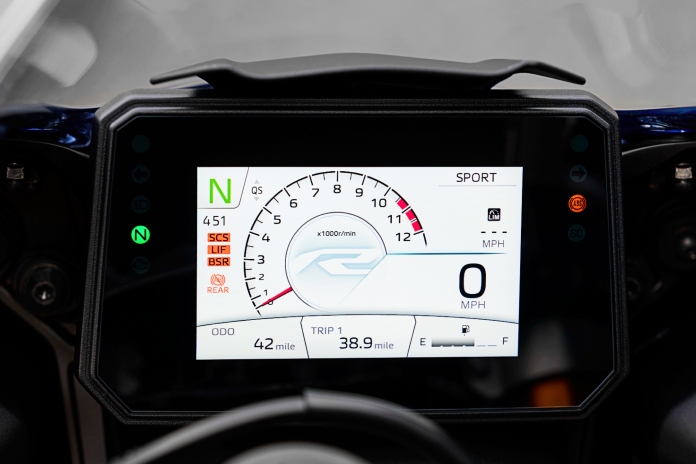
The 5-inch color TFT display has five themes to choose from, including one for use on the track. Pairing several smartphone apps (Yamaha Y-Connect, Yamaha Y-TRAC Rev, and Garmin StreetCross) enable a full range of multimedia features, on-screen navigation, a virtual pitboard, and data logging.
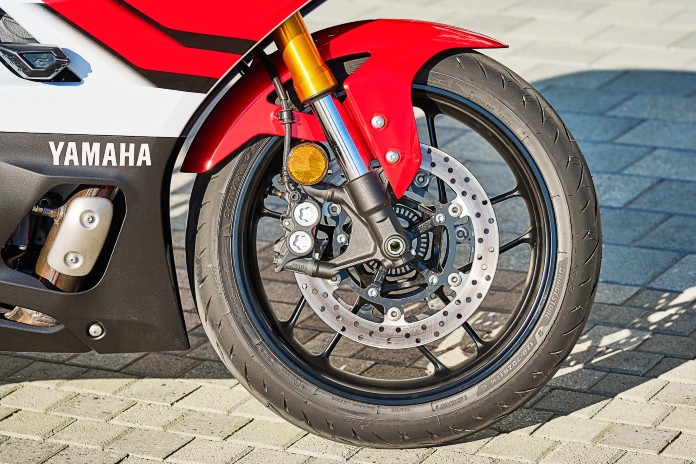
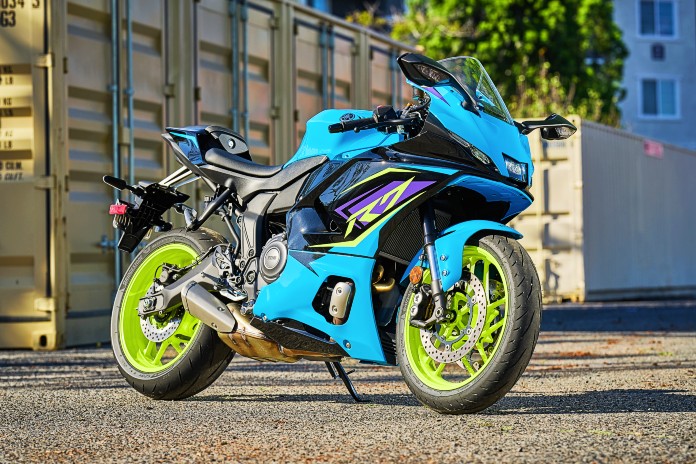
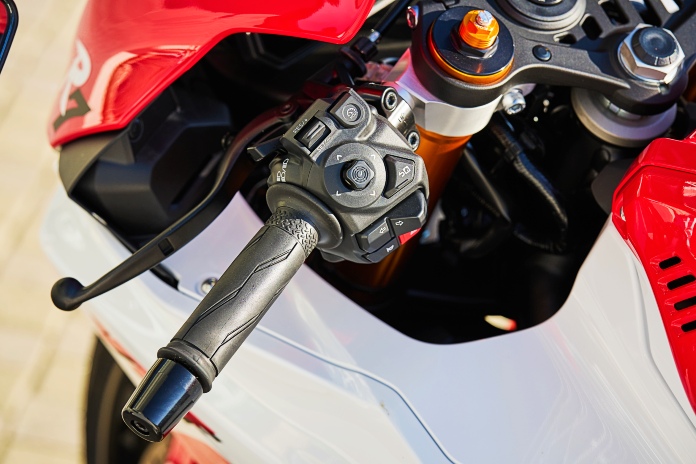
Looks are important to sportbike buyers. Even though the new YZF-R7 is priced well below 10 grand ($9,399 to be exact), its styling is on par with bikes that cost twice as much. Its sleek front end, LED position lights and headlight, and LED turnsignals embedded in the mirrors are derived from the top-of-the-line YZF-R1M. It also has a MotoGP-inspired triple clamp, black anodized clutch and brake levers, and updated handlebar switches.
When Yamaha introduced the YZF-R7 in the summer of 2021, it hosted a track-only press launch at Atlanta Motorsports Park. Recognizing its primary use case, this go-round we tested the R7 on the street, including freeways, city streets, and canyon roads.
Few of us are lucky enough to live at the base of a fantastic motorcycle road. Most of us must ride a while to get to twisties. We have to escape the city or suburban sprawl, endure an hour or so on the interstate, or just drone along on flat, straight roads before things get interesting. This sort of riding is not the R7’s happy place. Sure, it now has cruise control, but even with the revised ergonomics the riding position puts a lot of weight on the rider’s wrists. Also, on the particular bike I was riding, the engine threw off excess heat, roasting my inner thighs.
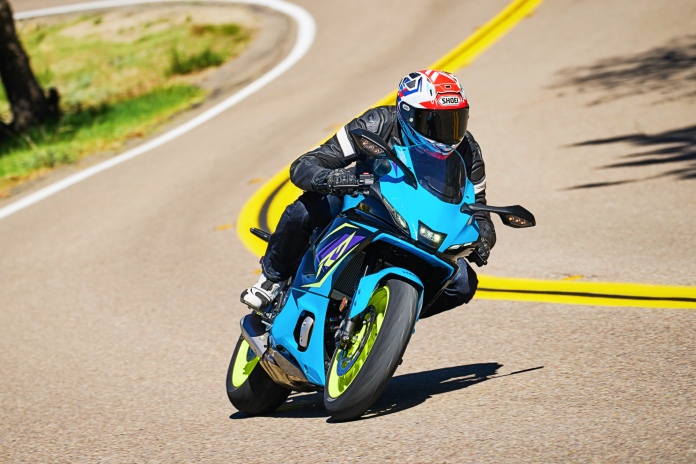
For the first 50 miles, I wasn’t a fan of the new R7.
Then we turned onto California State Route 76. Stop lights and traffic gave way to smooth pavement and a series of nicely banked curves that ascended into the Peninsular Range of northern San Diego County. On the sides of its grippy tires, the R7 was in its element.
A few miles later, we turned onto South Grade Road, which climbs to the top of Palomar Mountain. This is one of California’s premier motorcycle roads, particularly among sportbike aficionados. In less than 7 miles, South Grade Road gains 3,000 feet of elevation as it slithers around 50 curves, 21 of which are switchbacks. I forgot about ergonomics and engine heat and focused on smooth throttle control and correct steering inputs.
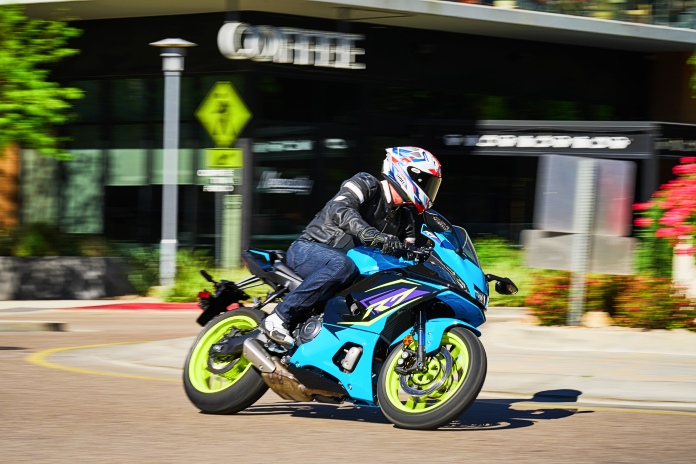
Here’s where the R7 shines like the North Star. What has always made Yamaha’s “crossplane concept” engines so appealing is their low-end torque and their rumbling sound and feel. Sure, you give up the top-end hit of an inline-Four, but on the street midrange is king. Even though the revised transmission internals, slip/assist clutch with a 14-way adjustable lever, and quickshifter make gear changes effortless, the tractable Twin allowed me to stay in 2nd or 3rd gear and just use the throttle for acceleration and engine braking for deceleration.
Part of South Grade Road was repaved not long ago, and it’s silky smooth. But the upper section has older pavement with dips, cracks, and seams that feel destined to upset a motorcycle’s chassis. Not so on the R7. The reworked frame and swingarm were rock solid, and the revised suspension felt firm but not flinty. Regardless of lean angle or speed, the bike remained planted and responsive.
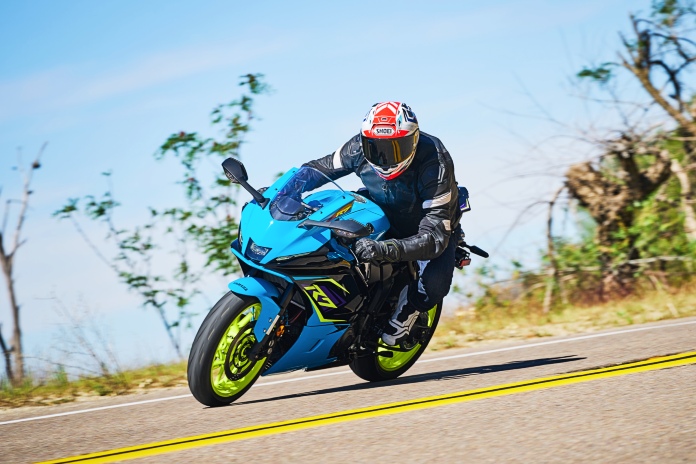
From the top of Palomar, we turned onto East Grade Road, which runs along a mountain ridge for a while before descending to SR-76 through a series of flowing curves. A small group of us rode nose-to-tail, like the cars of a train moving along a track, keeping a steady rhythm for the better part of 10 miles. The R7’s Bridgestones clung to the tarmac and allowed for easy transitions from one curve to the next. Its radial front calipers, with hydraulic fluid pushed through a Brembo master cylinder, scrubbed off speed confidently with a light pull of the lever.
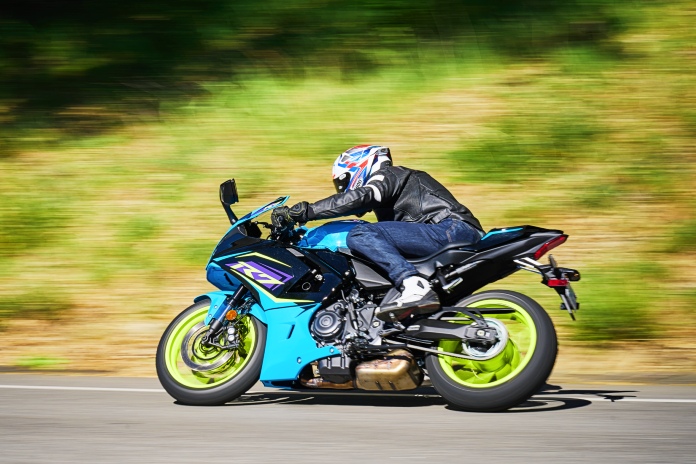
The fun continued on Mesa Grande Road and a few others that followed, the R7 shining brighter with each mile. No, I did not enjoy droning back to the hotel. But getting a chance to ride the R7 on good roads made it worthwhile.
For just $200 over last year’s model, the 2026 Yamaha YZF-R7 offers a wish list of useful upgrades. It’s now the full package, a nicely refined sportbike that has all the features and capabilities you could want. No doubt it will remain at the top of Yamaha’s sales charts.
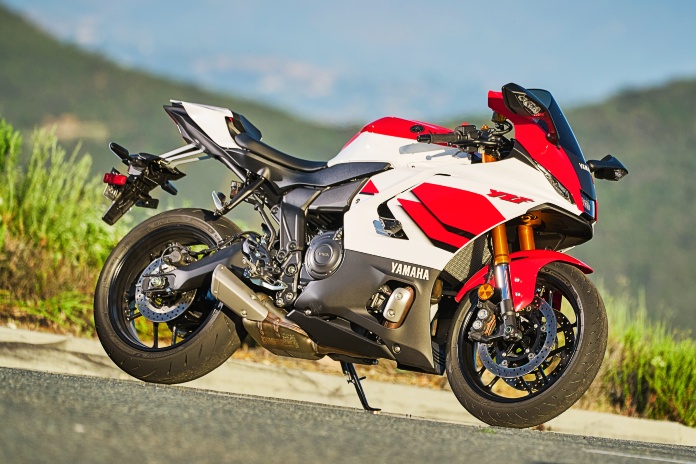
Check out more new bikes in Rider’s 2026 Motorcycle Buyers Guide
2026 Yamaha YZF-R7 Specs
- Base Price: $9,399
- Website: YamahaMotorsports.com
- Engine Type: Liquid-cooled, transverse parallel-Twin, DOHC w/ 4 valves per cyl.
- Displacement: 689cc
- Bore x Stroke: 80.0 x 68.6mm
- Horsepower: 72 hp @ 8,750 rpm (factory claim)
- Torque: 50.2 lb-ft @ 6,500 rpm (factory claim)
- Transmission: 6-speed, cable-actuated slip/assist wet clutch
- Final Drive: O-ring chain
- Wheelbase: 54.9 in.
- Rake/Trail: 24 degrees/3.6 in.
- Seat Height: 32.7 in.
- Wet Weight: 417 lb
- Fuel Capacity: 3.7 gal.