
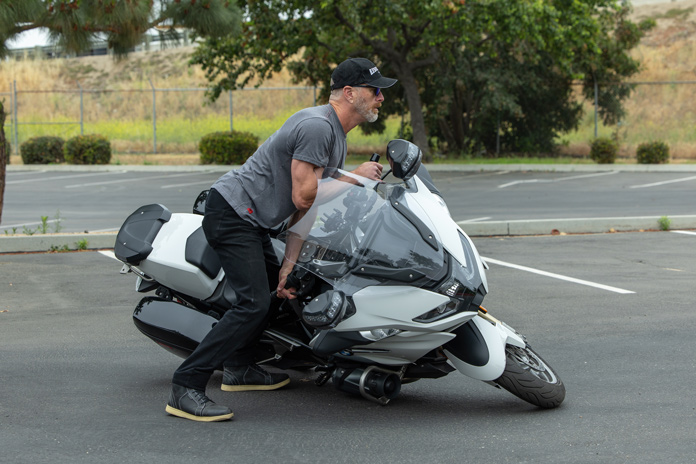
Just then, something caught his eye. Working traffic enforcement on his BMW R 1200 RT-P, Corporal Jeff Corbin zeroed in on a Romance Red Mazda Miata executing an illegal left-hand turn. And thanks to three heaping scoops of pre-workout before his gym session, Jeff was like a carnivorous bird of prey, divebombing down to ambush yet another poor unsuspecting commuter that sped through its hunting grounds. Within seconds, Jeff smashed the start button, jumped into traffic, and stopped the Miata directly in front of Buena High School in Ventura, California.
Allow me to set the stage here. Imagine vigorous morning traffic, kids en masse flooding the entrance to the school, and a gaggle of firemen out for their morning 5K jog and juice pep step. In short, God and everybody was there to witness Jeff take charge of his traffic stop. Oh, and a key component of the story I forgot to mention: The road Jeff was patrolling was heavily crowned, so he was stopped on a steep incline. But more on that in a moment.
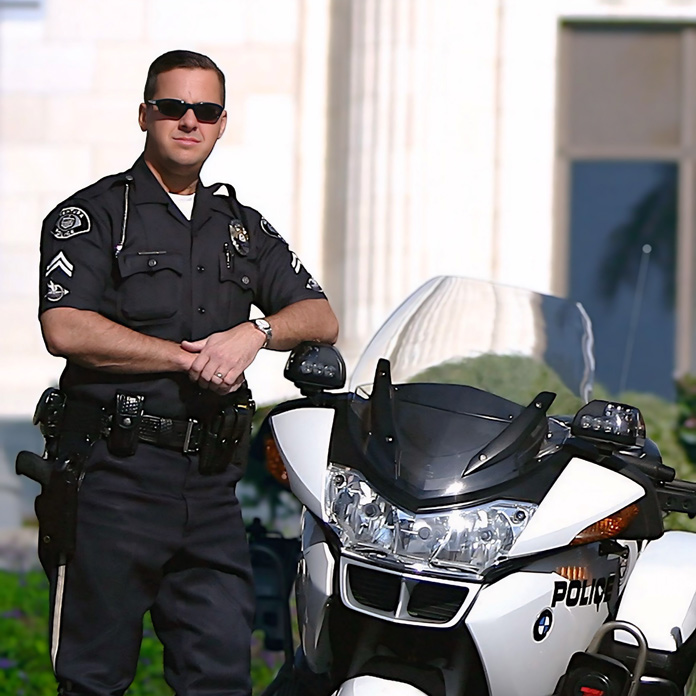
Jeff went through his muscle-memory dismount as usual: kill the bike, unplug the coms, identify cover and concealment, track any movements from the vehicle, and finally, lock out the kickstand and dismount. It was this last part that left Jeff cold and sober, because he suddenly realized that the bike was vertical, with almost no weight resting on the kickstand. But by then it was too late. The big Beemer stayed topside just long enough for Jeff to give it one last glimpse before it collapsed onto the cold, damp concrete and pinned itself against the curb. Little by little, Jeff’s tunnel vision faded to the sights and sounds of kids, commuters, firemen, and the man upstairs himself hooting in amusement at his predicament.
But let’s be honest. All of us, at some point or another, have been Jeff. Maybe not in full police uniform while hundreds of commuters and high schoolers laugh and point at us, but to some degree. It’s miserable (yes, I’ve been there too) because not only are you embarrassed, but you still have a downed and possibly damaged motorcycle to sort out.
So today, in solidarity with my long-time buddy Jeff, I’m going to show you a variation on the typical “three points of contact, put your butt against the seat, squat-lift” technique of picking up a downed motorcycle. Why try this one? It works great on slippery surfaces or for motorcycles that settle a bit lower to the ground after they hit the deck. Let’s begin.
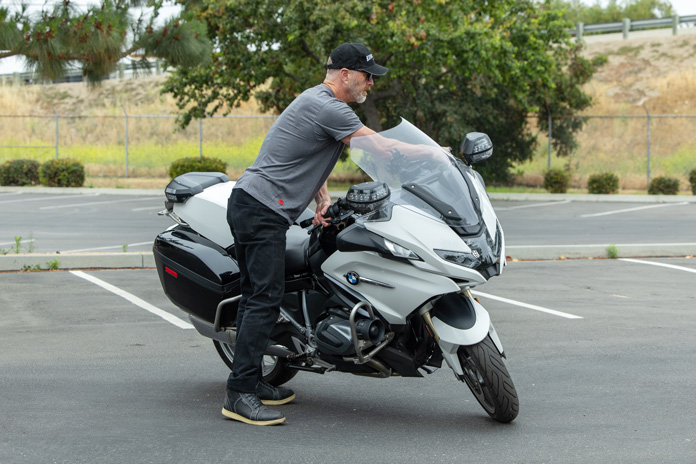
To start, let’s assume your motorcycle fell on the rear-brake-lever side, opposite the kickstand. We will also assume you are able-bodied and not injured in any way.
Step 1) Turn the ignition off. I like to just go ahead and shut the bike off because odds are we will have to cycle the ignition to get going again anyways. Plus this ensures the bike won’t fire up if I accidentally hit the starter button during lift-up.
Step 2) Fold out the kickstand, since we will want to set it on the stand once it’s back up on its feet.
Step 3) Try to ensure your bike is in gear. I usually push down on the shift lever with my hand and then push on the wheel with my foot to check that it’s in gear. Unfortunately, some rear tires will contact the ground when the bike is down, so you will not be able to execute the spin test to determine if you are in neutral. When this happens, I just assume it’s in neutral.
Step 4) Walk over to the side that the bike is currently laying on (in this case, the right side) and turn the handlebar to the right (the throttle will be nearest the tank).
Step 5) Facing the motorcycle, squat down with feet shoulder-width apart and wrap your left hand around the right-side grip (throttle side). Note: Because we are assuming the bike is in neutral, we will use our left-hand index finger to squeeze the front brake as we hold the grip so it can’t roll when we start to pick it up. Then, using our right hand, we will grab the left-side grip (nearest the clutch lever) for additional stability.
Step 6) Pay close attention to the direction of your front tire. If you glance down, you will notice the front wheel is facing at an approximate 45-degree angle off to the right. That means we want to generate forces directly into that angle, or perpendicular to the tire. So rather than just generating a sideways force (90 degrees) by pushing directly into the motorcycle, we will push at a 45-degree angle (towards the left-side mirror). Why? Because perpendicular force towards the tire will minimize rolling movement and maximize traction for the lift, especially if the surface is slippery or low traction.
Step 7) As we squat down with our legs and keep our back straight, we will start lifting the motorcycle. But as we do this, we want to make sure that the left arm is “locked out” and not using any muscle strength to pull the bike up. In short, think of your left arm as a chain that holds and secures the load, while your legs provide the actual lifting movement. As for the right arm, it is just there for stability and doesn’t do any lifting either.
Step 8) Lift with your legs and push into the motorcycle at a 45-degree angle (again, perpendicular to the front tire). The bike will lift quickly and smoothly and remain stable and steady in the process.
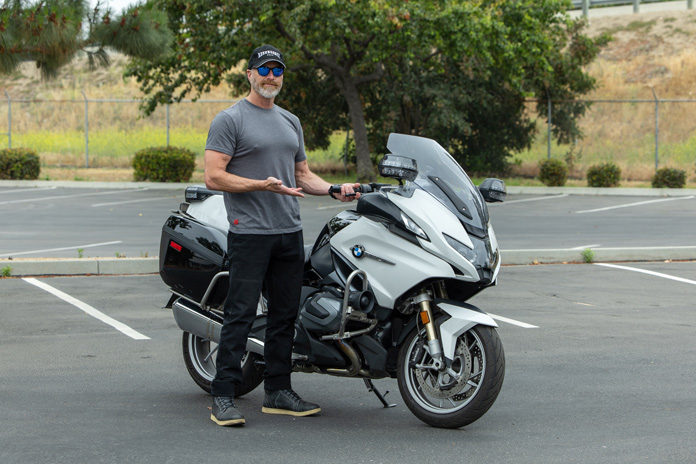
While I didn’t go by the numbers for a bike drop on the kickstand side, just remember: If the bike falls on the right side, turn the bars to the right; if the bike falls on the left side, turn the bars to the left. And just as before: right grip = grab with left hand; left grip = grab with right hand. The great news here is that while lifting your bike from the non-kickstand side can be scary, it is precisely in this scenario that this technique shines. That’s because it allows much better control during the lift, minimizing the tendency to over-lift when you put your back into it and send it up and over the other way (ask me how I know this can happen).
As for Jeff’s early morning traffic demonstration? Moments after the bike hit the deck, Jeff skillfully negotiated a roadside barter with the driver, who assisted with picking up his bike in lieu of a citation. This quick thinking enabled Jeff to arrive at our regularly scheduled coffee ritual on time and without breaking a sweat.
To see this technique in action, watch the video below.
Quinn wears Schuberth helmets and Lee Parks Design gloves. Find out more at Quinn’s website, PoliceMotorTraining.com. Send feedback to rider@ridermagazine.com.
See all Motor School with Quinn Redeker articles here.

This is very helpful. One thing that I’m going to do though, is to go out on the lawn, lay my bike down, and practice this a time or two. I don’t want the first time I do this to be out in public.
Great idea! And please grab a lawn chair so I have some comfort while I watch. Oh, and a beverage would be great too!
This is a great technique I hope to never need. I’ve picked up an ST1300 and an R1200RT, all by my short boney self, using the push-your-butt-against-the-side method. But this approach appears to better leverage our friend physics. The video is especially helpful. TYVM
I’ve never seen the alternative technique before, good stuff. Any suggestions for us creaky, damaged retirees? I’m working with a hip replacement, one knee ready for replacement and a recent back fracture injury. Is there anything I can try or just call for AAA?
I think it depends on the person, the location, and the motorcycle for a useful reply to your question. If you struggle with lifting heavy bikes, I would suggest either: 1) get a smaller lighter bike, or 2) get some wide engine guards so the bike doesn’t fall so far over when you do drop it. That way the crash bars already did some of the heavy lifting for you! 3) Start riding with a group of people who can help out. In police motor schools, we had a rule that no riding students were allowed to pick the bike up by themselves. It had to be a minimum of 3 people. As you can imagine, we drop our motors multiple times a day over weeks, so it can get quite taxing!
Thank you for the excellent video sir. I can identify with Corporal Corbin having dropped my motor more than once in front of an audience. In 1989 I was a LAPD motor officer assigned to West Traffic Division. A divisional inspection by Chief Parks was scheduled for that morning involving motors and I arrived late due to helping a stranded motorist. When I arrived at the station I saw that all of the bikes were lined up with my fellow motor officers standing at attention next to their mounts. Chief Parks was beginning the inspection when I turned into the driveway and immediately regretted my decision. Committed now, I pulled into the formation and deployed the side stand. Hearing the familiar “clunk” indicating it was down, I began my dismount. Unfortunately, the side stand makes a similar sound when it goes down half way and pops back up and I dropped the bike in front of the entire squad and the chief. I didn’t live that down for years. Still riding at 78!