
JT Nesbitt’s idea of designing a motorcycle that can last 100 years isn’t just about durability, it’s a design philosophy rooted in longevity and resistance to disposable culture.
At the core of his thinking is a rejection of modern production cycles, where machines are often designed around short-term relevance and planned obsolescence. Instead, Nesbitt treats a motorcycle more like a piece of industrial art or architecture, something that should age with dignity, remain serviceable, and still matter decades after its creation.
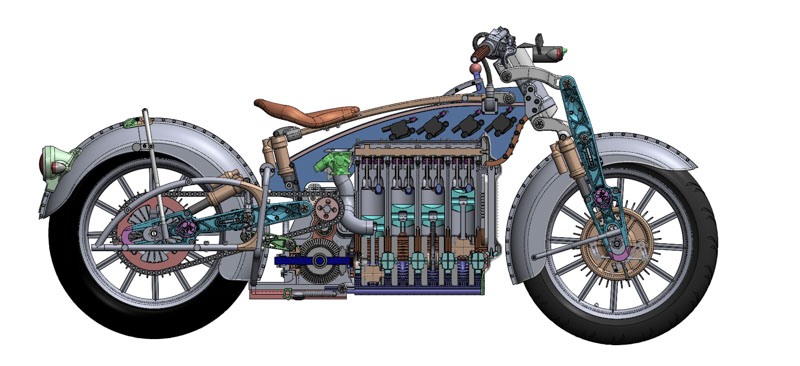
A 100-year motorcycle, in his view, has to be built on a foundation that transcends fashion. That means mechanical simplicity where possible, repairability over replacement, and materials that age well rather than degrade quickly. It’s about making every system understandable, accessible, and capable of being maintained by future generations who may not have factory support or diagnostic tools.
There’s also a cultural layer to it. His inspiration comes from early American motorcycles, industrial-era craftsmanship, Japanese sword metallurgy, aviation logic, and even broader artistic influences. The idea is that a machine should feel like it belongs to a longer continuum of design history, not a single product cycle.
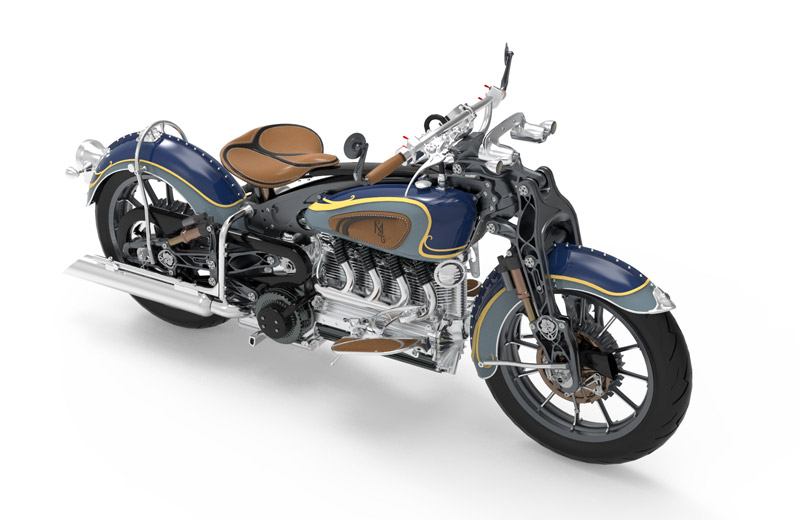
In that sense, a 100-year motorcycle is an argument against obsolescence itself. If it’s well-conceived, it should be worth keeping alive indefinitely.
At the heart of the 100-year motorcycle idea is a simple principle: reduce everything to what is absolutely necessary, then make those parts as strong and serviceable as possible. Instead of layering complexity onto performance, the design philosophy strips the machine down to its most durable mechanical core.
Rule 1: Make it Simple
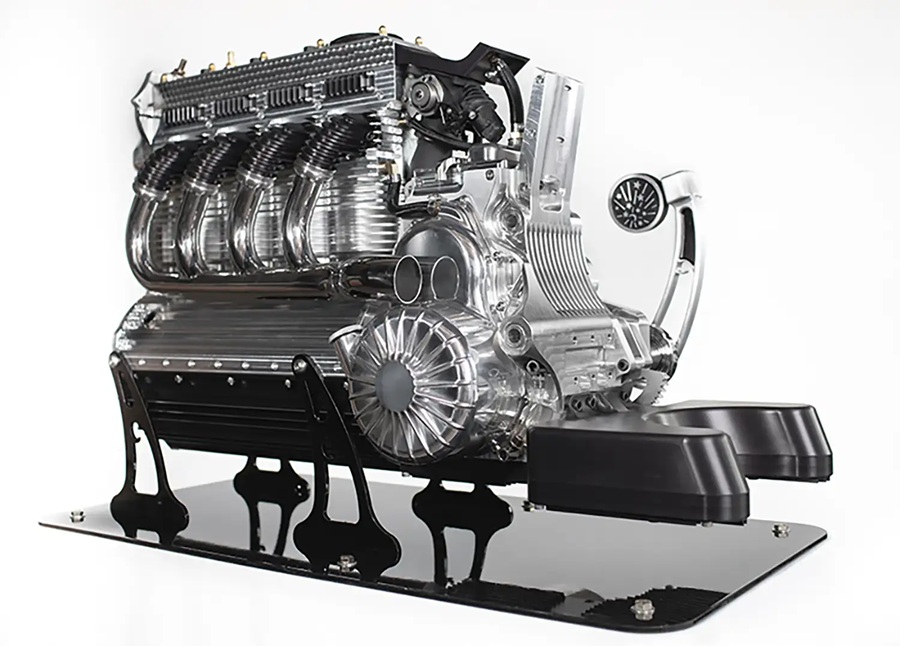
Reductive mechanical design is the first rule Nesbitt has followed in the design of the Maglonia 4. That means using the fewest possible component parts and eliminating unnecessary systems entirely. The engine uses overhead cams driven by bevel gears and a shaft instead of a cam chain, removing multiple wear points and moving parts. Valve actuation happens directly over the cam, which eliminates rocker arms altogether.
The transmission is a simple 3-speed unit designed to take advantage of engine torque, using only a single shift fork and no shifter drum or PAL-style mechanism. Even the starter system is simplified. The starter motor and generator are combined into a single unit with no sprag clutch or intermediate drive components. An oil screen replaces a traditional disposable filter, further reducing service complexity. Fewer moving parts and stronger individual components means longer life.
Rule 2: Eliminate Fluids
The second rule is to use the least number of fluids as possible and simplify what remains. The only essential fluids are oil and fuel. The engine is designed with just three radial oil seals in the powertrain, and instead of relying on traditional gaskets, mating surfaces use RTV sealant throughout. Cooling is handled through an optimized fin design, eliminating the need for a water-cooling system entirely.
Even braking is reconsidered. Drum brakes are used for their longevity and mechanical simplicity, avoiding hydraulic brake fluid entirely. The wheel design is also rethought to help manage heat, drawing inspiration from Ettore Bugatti’s approach to mechanical elegance and thermal efficiency. The goal is to remove systems that degrade, leak, or require constant maintenance over time.
Rule 3: Limit Electronics
The third rule is to limit electronics to only what improves reliability. In this philosophy, simple non-sequential port fuel injection is preferred over carburetion for consistency and durability, and electronic ignition replaces mechanical points for long-term reliability.
Beyond that, electronics are intentionally minimized. The motorcycle is designed with a kickstarter, eliminating the need for a battery-dependent starting system altogether. The intent is not to avoid modern technology, but to use only what demonstrably increases longevity while removing everything that introduces unnecessary failure points.
The Legacy of 100 Years
The Magnolia 4 is an exercise in restraint and intention. The result is a machine shaped as much by what has been left out as what has been included, where durability and clarity of design take priority over short-term innovation cycles.
That thinking is what defines its “100-year” ambition. It’s a philosophy that treats the motorcycle less like a consumable product and more like a long-term mechanical companion. For a deeper look at the mind behind it, readers can explore our featured profile on JT Nesbitt (published in the June 2026 issue), where his broader design influences and approach are examined in greater detail.
Nesbitt’s 100-year motorcycle ultimately asks a question completely opposite of the rest of the motorcycle industry.
What would it take for a machine to outlive the era it was born in, and still feel relevant when it does?
To learn more about JT Nesbitt and the Magnolia 4, read our feature JT Nesbitt: An American Original, visit the Bienville Studios website, and listen to our interview with him on the Rider Magazine Insider Podcast.






It’s the Wonderful One-Hoss Shay.
I was about to post the same thing. Reminded me immediately of the poem.
It has real fenders!
I am reminded of the fleet of 1920s Ford Tri-Motors out of Port Clinton, Ohio; that were flying daily service into the 1980s. And a fleet of a half-dozen or so 100yo Ford Model T’s in daily service carrying visitors on rides at the Henry Ford Museum. While both examples carried passengers decades after being built, neither one could really be considered relevant 40-50 years after they were built.