

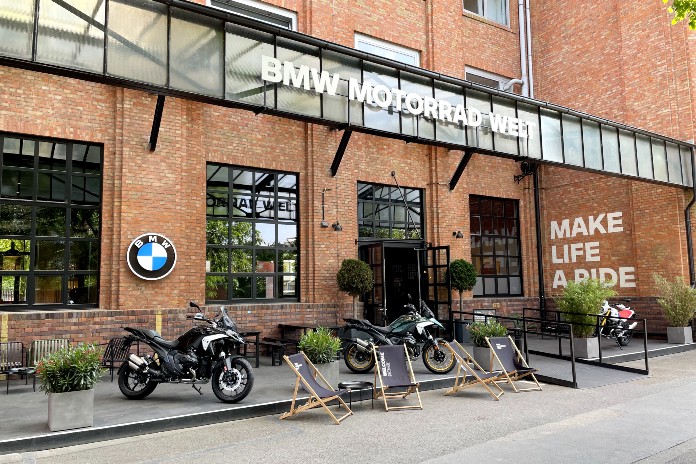
Nestled in the historic district of Spandau in Berlin, the BMW Motorradwelt visitor center, together with BMW’s adjacent production plant, stands as a powerful testament to both legacy and innovation. Approaching the facility, what immediately strikes the visitor is the seamless fusion of past and present — century-old industrial structures carefully repurposed and blended with striking contemporary architecture. This juxtaposition captures BMW’s journey in a single glance: from its early days of precision craftsmanship to its current role as a global leader in motorcycle engineering.
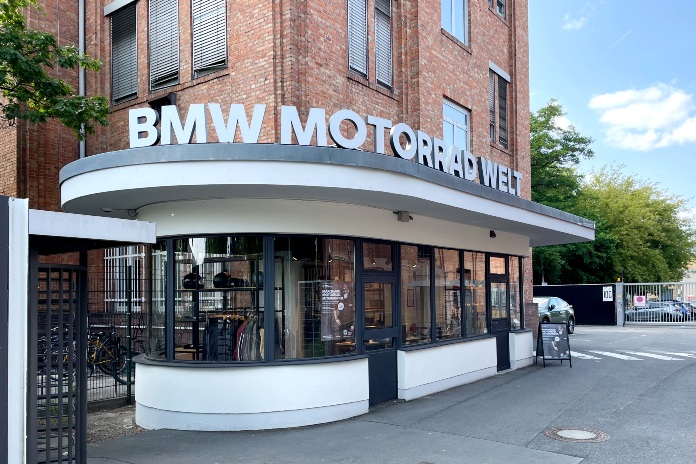
Just outside the main entrance, the forecourt greets visitors with an ever-changing line-up of BMW motorcycles. These range from the latest machines fresh from the production line to historic models and unique custom builds that highlight the creativity, heritage, and bold spirit of the brand. Each motorcycle, polished to a mirror finish under Berlin’s northern light, invites visitors to pause and reflect on the stories preserved in every curve of metal and every finely crafted detail.
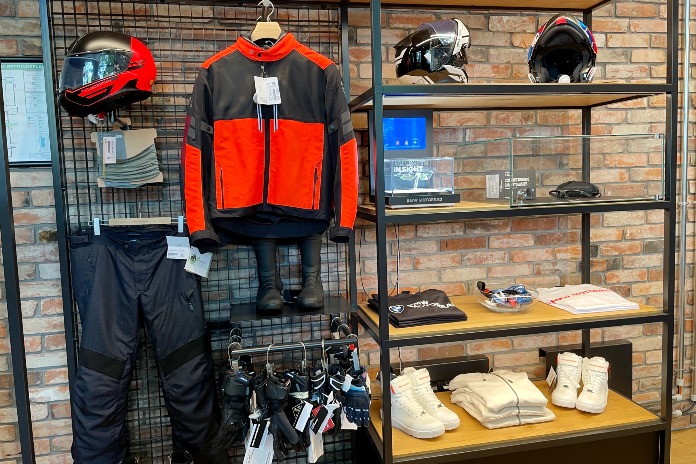
Stepping through the expansive glass doors, the atmosphere inside Motorradwelt shifts to one of purposeful calm – part museum, part cultural center, part community gathering place. On one side, a welcoming cafe offers espresso and other delicacies, encouraging visitors to relax and absorb the ambiance. Nearby, a retail store presents the latest BMW helmets, jackets, gloves, boots, and lifestyle accessories.
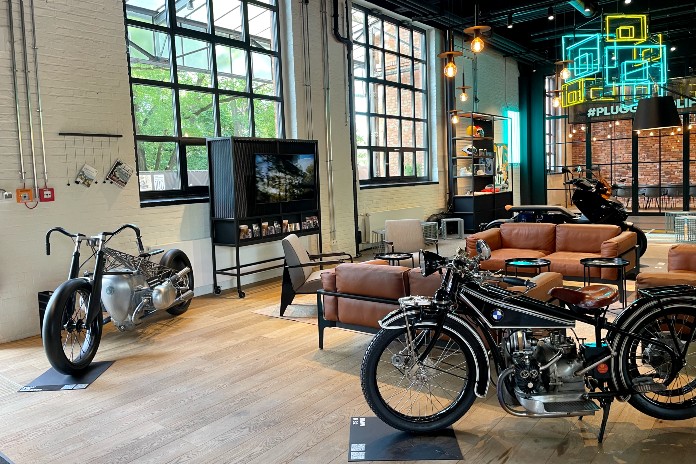
Yet the true heart and soul of Motorradwelt are the motorcycles themselves – machines that function not only as artifacts of history but as living embodiments of a century of passion, precision, and relentless innovation. As you wander from one exhibit to another, a clear thread emerges: BMW’s story is not told in abstract concepts or corporate slogans, but in metal, rubber, oil, and design.
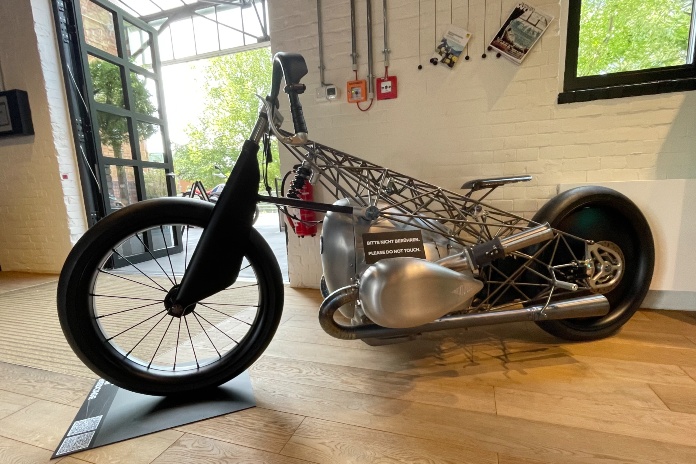
Among the most captivating exhibits is the BMW Birdcage, a one-of-a-kind custom created by Revival Cycles in the United States. More than a motorcycle, it is a moving sculpture. Its frame, a delicate lattice of lightweight titanium rods, cradles BMW’s massive 1,800cc Big Boxer engine with the fragility of a bird’s nest. The lack of bodywork exposes every mechanical element – from the gleaming shaft drive to the intricately machined castings – transforming engineering into aesthetic expression.
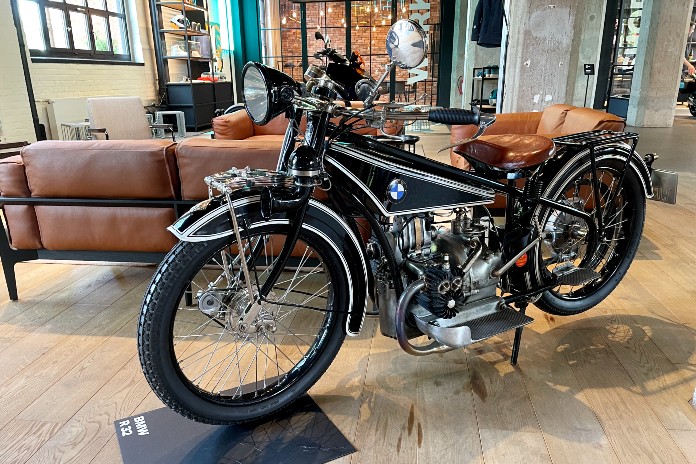
From futuristic custom to century-old original, the transition to the revered BMW R 32 could not be more striking. This machine, the very first motorcycle produced by the company in 1923, is both modest in its outward appearance and revolutionary in its technical achievements. Its understated black paint, adorned with elegant white pin striping, conceals an engineering breakthrough. Designed by Max Friz, the R 32 introduced the horizontally opposed twin-cylinder boxer engine and shaft drive – hallmarks that have defined BMW motorcycles for more than a hundred years with only minor evolution.
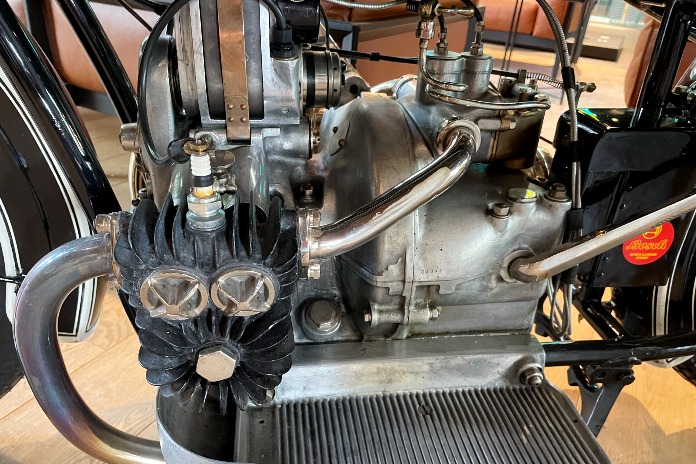
Standing before it, one cannot help but reflect on how one design decision – the adoption of the boxer engine layout – set the course of an entire century of motorcycle development. The R 32’s simple yet purposeful lines speak to a time when innovation and durability went hand in hand, laying the foundation for everything that followed. In many ways, all the other motorcycles on display here can trace their lineage back to this unassuming black-and-white pioneer.
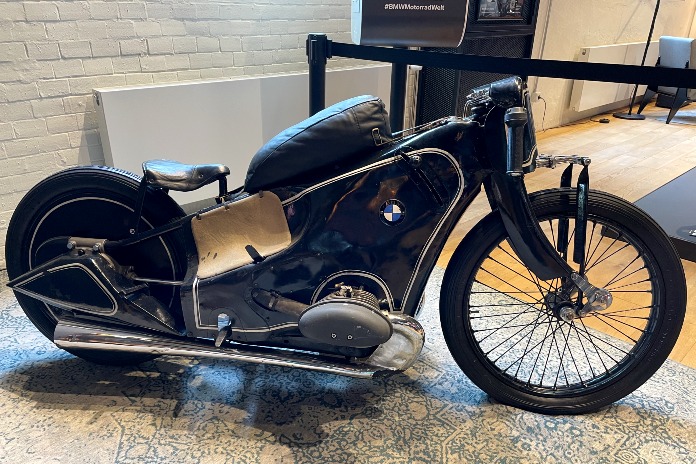
Close to the R 32 stands the formidable BMW WR 750, a supercharged racing machine from the 1930s. Built for speed records and endurance races, its elongated frame and stripped bodywork exude mechanical aggression rarely seen today.
One can almost imagine the shrill whistle of the supercharger and the thunder of its exhaust reverberating across Europe’s historic raceways. The WR 750 embodies BMW’s unbroken commitment to motorsport. For visitors moving from the R 32 to the WR 750, the shift is dramatic: from a machine created to prove reliability and introduce a brand-new concept to one designed to test limits and shatter records. Together they illustrate how quickly BMW transitioned from a newcomer to a force in the competitive motorcycling world.
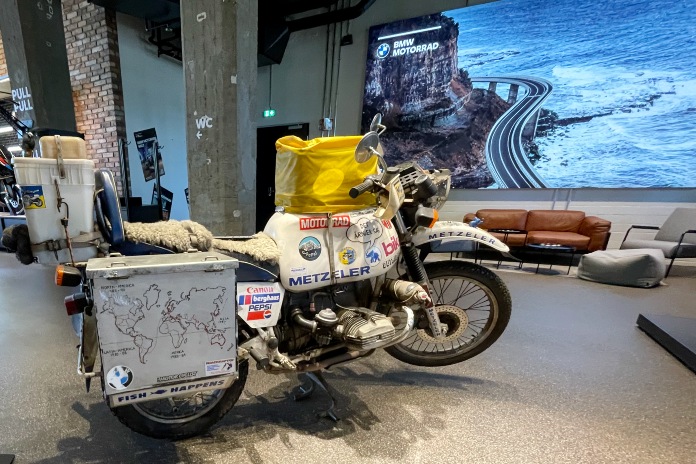
If racing represents one pillar of BMW’s legacy, adventure represents another, embodied here by Helge Pedersen’s battle-worn BMW R 80 G/S. This motorcycle has travelled more than 250,000 miles across 77 countries, bearing scars and stories in equal measure. Dents, faded stickers, and scrapes make it immediately distinct from the polished showroom machines nearby. Pedersen’s R 80 G/S speaks not just of miles covered but of encounters with landscapes and cultures around the globe. It represents the pioneering essence of the GS series: rugged, reliable, and endlessly adaptable.
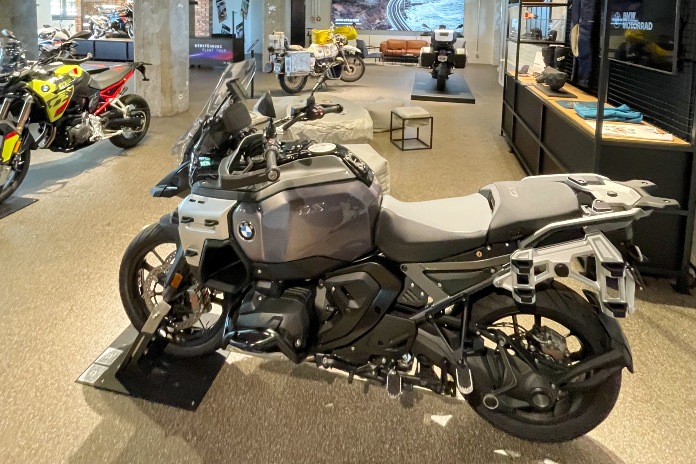
After reflecting on machines of history and adventure, attention naturally shifts to the future. Motorradwelt presents BMW’s newest models not as isolated products but as part of a continuum – designs that inherit the DNA of the R 32, the WR 750, and the R 80 G/S while pushing performance, comfort, and technology into new realms.
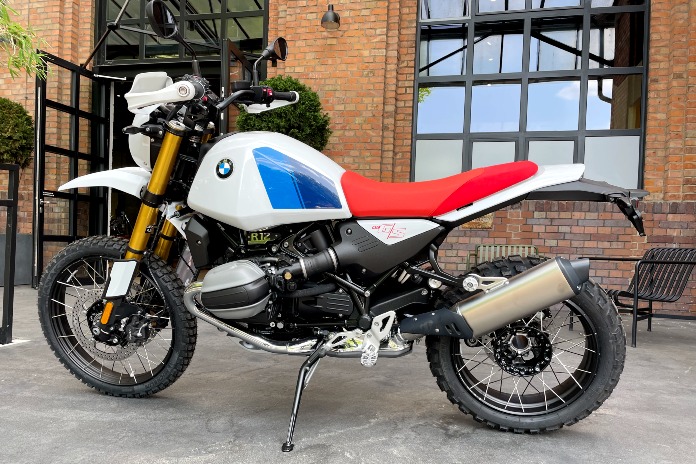
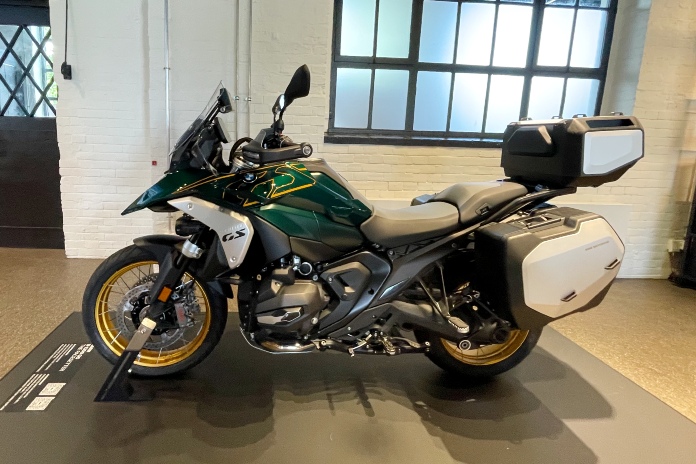
The new R 12 G/S proudly combines classic GS styling with advanced electronics, rider-assist features, and refined ergonomics. Nearby, the latest 1,300cc models, including the R 1300 GS, highlight BMW’s continuous refinement of the boxer platform, boasting lighter weight, more power, and cockpit-like instrumentation. Also on display are BMW R 18 cruiser variants, alongside a striking artifact: the fuel tank from the Billy Idol Punk R nineT Scrambler built by Motorcircus Berlin.
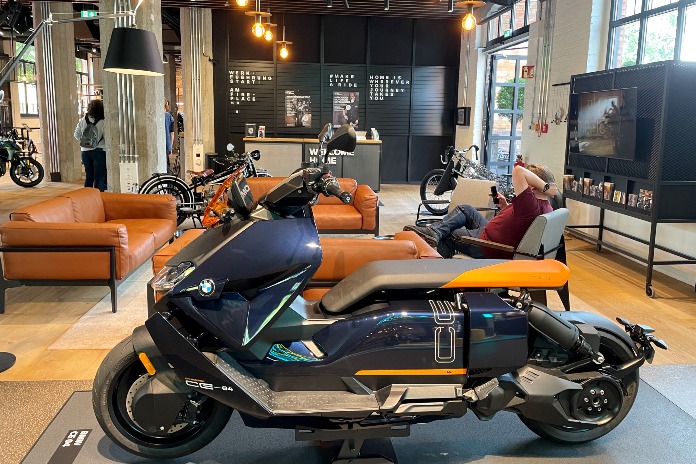
In another corner, the futuristic BMW CE 04 e-scooter draws attention. With its flat underfloor energy-storage system and compact drivetrain, the CE 04 demonstrates new design solutions, such as a side-folding charging compartment and a floating seat.
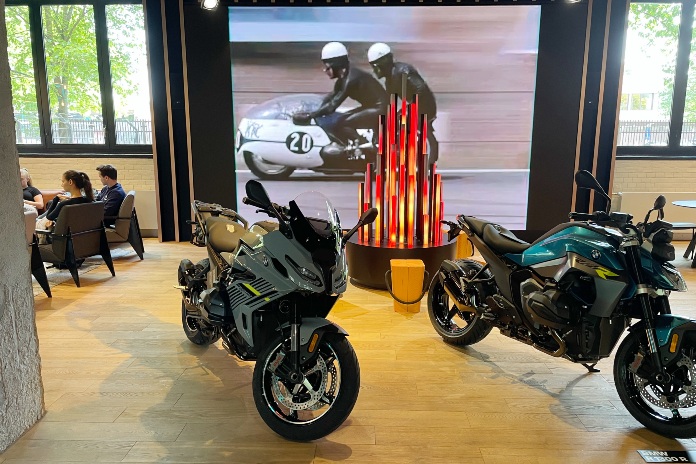
Then there is the S 1000 M superbike, a predator of the racetrack, its aerodynamic fairings and screaming engine built for ultimate performance. While far removed from the simple elegance of the R 32, it carries forward the same relentless pursuit of precision and engineering brilliance. In this way, Motorradwelt shows how the spirit of the past informs the machines of the present – and how both will shape the motorcycles of tomorrow.
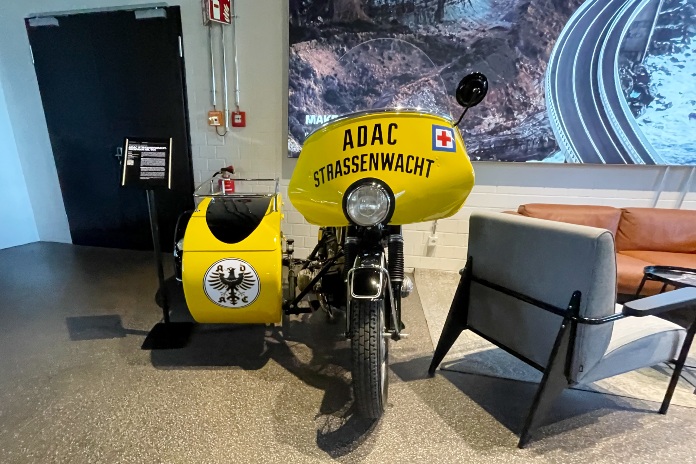
BMW’s heritage also includes the everyday service of machines designed to assist others. Among the exhibits, a bright yellow BMW ADAC sidecar reminds visitors of this vital role. Once used for roadside assistance by Germany’s automobile club, it is a symbol of dependability and community. Its cheerful paintwork and practical design speak of another side of motorcycling culture – one less glamorous but no less important.

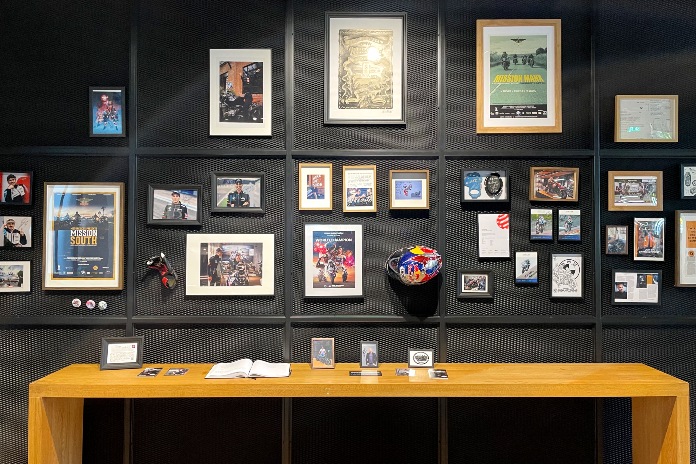
Walking deeper into the exhibition space, visitors find themselves surrounded by vivid photographic frames portraying BMW’s contemporary racing champions – names such as Tom Sykes, Peter Hickman, and Ilya Mikhalchik. These images do more than decorate the walls; they create a bridge between past and present, linking the thundering WR 750 of the 1930s with today’s superbikes competing on international circuits.
The effect is a reminder that BMW’s motorsport heritage is not confined to museum pieces but continues to evolve on the world stage. It is a living tradition, and Motorradwelt positions visitors right in the middle of it.
After taking in so much history and technology, the human touch of Motorradwelt comes as a welcome pause. The cafe offers a place to reflect, swap impressions, or plan the next stages of a Berlin journey. Nearby, the retail section entices visitors with the latest gear, from helmets and gloves to casual wear.
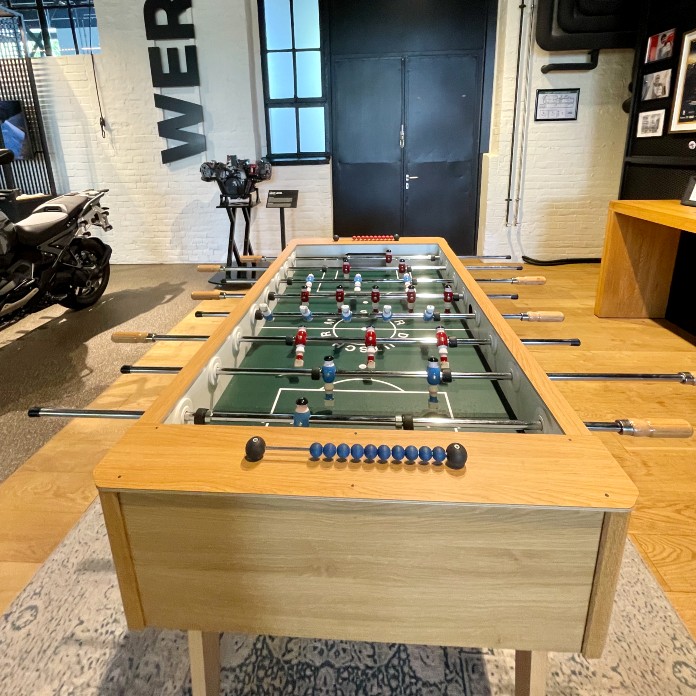
Then, tucked in a corner, a soccer table surprises and delights. In a venue dedicated to high-performance machinery, this playful touch reminds us that motorcycling is ultimately about joy – about shared moments, fun, and friendship as much as technology and speed. It is details like this that make Motorradwelt not only a showcase but a cultural space, inviting enthusiasts and casual visitors alike to connect with the brand on a human level.
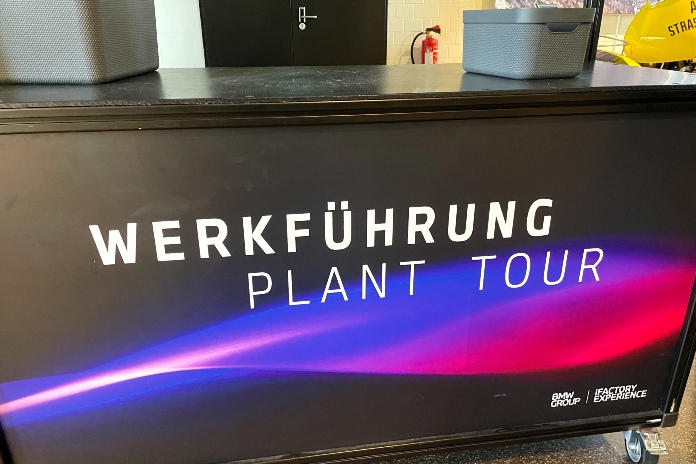
The pre-booked guided factory tours begin inside Motorradwelt, where our small group gathered for the last visit of the day. A knowledgeable Berlin-born guide led us into the heart of BMW motorcycle production.
The tour revealed a carefully choreographed process, blending the latest automation with human expertise. Roughly 2,200 employees, working in shifts, produce up to 900 motorcycles daily, primarily for Europe and North America. The logistics center, described as the most advanced in the industry, moves nearly a million parts per day, storing them in a 36-meter-high warehouse and delivering them to assembly lines with electric trains just in time.
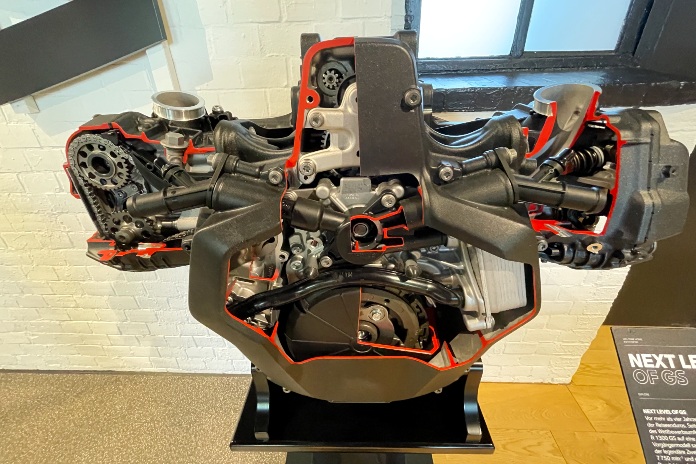
Although the paint shop had already closed for the day, we learned that it processes up to 10,000 parts daily in more than 25 colors, combining robotic efficiency with the artistry of hand-applied pin striping on tanks and fairings. Carrying on, mechanical manufacturing uses over 140 CNC machines to produce critical parts with tolerances finer than a human hair, while engine assembly lines bring boxer, inline-Four, and inline-Six engines to life under strict testing.
Before any motorcycle leaves the factory, it undergoes rigorous inspection. Every system is checked against more than 1,000 parameters on roller test stands. Welding, too, reflects a careful partnership between robotics and skilled technicians, particularly in the delicate fabrication of aluminium fuel tanks.
For visitors, the tour is not only informative but inspiring. It shows how tradition and innovation coexist on the factory floor just as they do in the exhibition halls of Motorradwelt.
As the tour concluded and visitors stepped back into the Berlin evening, the fading sun reflected off polished tanks and shining chrome on the forecourt. The sounds of the Spandau district blended with the hum of memory and inspiration, leaving a deep sense of connection — to a brand, a legacy, and a community of riders and engineers who have shaped motorcycling history.
For enthusiasts and dreamers alike, BMW Motorradwelt is a reminder that motorcycles are not just vehicles; they are vessels of history, imagination, and freedom. The next chapter always awaits – engine idling, ready for the twist of the throttle.
Planning a BMW Spandau Factory Tour
- Book online well in advance to secure a spot.
- Children under 14 are not permitted on site.
- Closed-toe shoes are mandatory.
- Photography is prohibited during the tour.
- Tours are available in English and German, with audio headsets provided.
- Prices range from €14.50 to €18.00 for a 100-minute guided tour.