
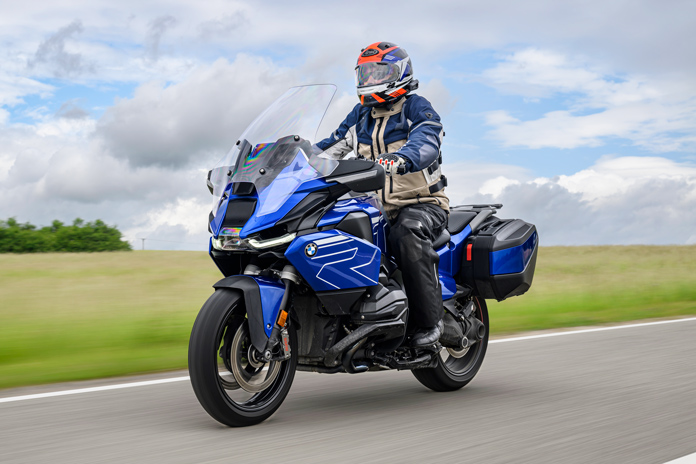
There’s just something right as rain about riding through the postcard-perfect German countryside on one of BMW’s latest motorcycles. Even if it does actually rain. We were in Germany for BMW Motorrad Boxer Days, a press launch that included technical deep dives and test rides on three new-for-2026 models: the BMW R 12 G/S adventure bike, the BMW R 1300 RT sport-tourer, and the BMW R 1300 R roadster (review coming soon).
R-series boxer-powered motorcycles are the life blood of BMW Motorrad. The first BMW motorcycle, the 1923 R 32, had an opposed flat-Twin (boxer) engine, a longitudinal crankshaft, and shaft final drive. Motorcycles with the same configuration have been in BMW’s lineup for over a century.
In the mid to late 1970s, BMW launched several variants of the 980cc R 100 platform: the R 100 S (for Sport, with a small bubble fairing like the one on the iconic R 90 S), the R 100 RS (for Reise, or Travel, Sport, the first production motorcycle with a full fairing), and the R 100 RT (for Reise Tourer, similar to the RS but with an enlarged fairing, Krauser saddlebags, and a heel-toe shifter).
The RT, which evolved into R 1100, R 1150, R 1200, R 1250, and now R 1300 versions, has always been one of BMW’s top-of-the-line touring models. The other has been the liquid-cooled inline 4-cylinder K-series LT (Luxury Tourer) models, which began with the K 100 LT in 1986 and continues today with the K 1600 GTL.
Rider has tested them all, and three have been selected as Motorcycle of the Year: K 1200 LT in 1999, K 1600 GTL in 2012, and R 1200 RT in 2014.
The point of this walk down history lane? BMW Motorrad takes touring seriously. It has been designing and building tourers with fairings, saddlebags, and other creature comforts for nearly five decades, steadily adding power, refinements, and technological improvements along the way. The R 1250 RT, introduced in 2019, was a fantastic motorcycle that set a high bar in the sport-touring segment. How much better could the BMW R 1300 RT possibly be?
Quite a bit, actually.
RT Reset
The BMW R 1300 RT is based on the same platform as the R 1300 GS that was introduced for 2024 and was Rider’s Motorcycle of the Year. It was a clean-sheet machine, a revolutionary redesign rather than just a bump in displacement and a few more bells and whistles. As we wrote in our review of the R 1300 GS, “only the butterfly valves and a few bolts and connectors carry over from the R 1250 GS.”
The RT’s engine is still an air- and liquid-cooled boxer, as it has been for more than a decade, and it retains the vertical-flow cylinder heads, variable oil intake, DOHC valvetrain with light cam followers, and ShiftCam variable valve timing system that were on the 1250.
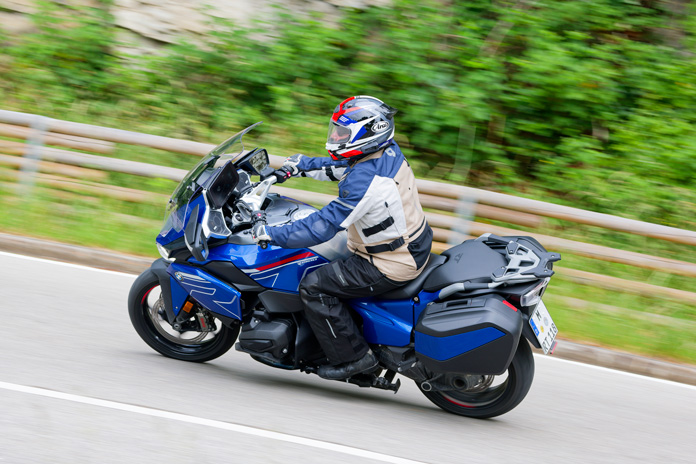
GEAR UP
- Helmet: Arai Contour‑X
- Jacket: Rev’It Sand 5
- Gloves: Rev’It Sand 5
- Pants: Rev’It Sand 5
- Boots: BMW
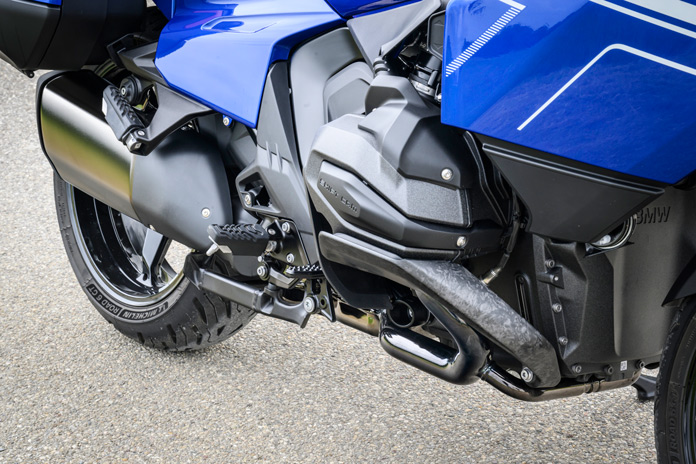
But the similarities end there. The new engine is more compact, weighs 8.3 lb less than its predecessor, and has revised internals. The cams are driven by a new timing chain arrangement, with the right cylinder’s timing chain in front of the cylinder and the left cylinder’s chain behind the cylinder. Cam timing has been revised, the valves are larger, and the compression ratio is higher (13.3:1, up from 12.5:1). A larger 106.5mm bore (up from 102.5) and a new crankshaft with a shortened 73mm stroke (down from 76) boost displacement from 1,254cc to 1,300cc.
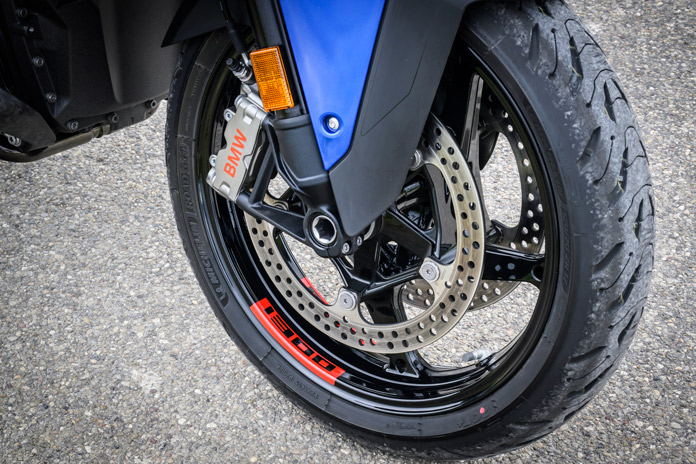
Compared to the R 1250, the R 1300 generates more horsepower (145 at 7,750 rpm, up from 136), more torque (110 lb-ft at 6,500 rpm, up from 105 lb-ft at 6,250 rpm), and a broader spread of torque. A new lightweight 2-into-1 stainless steel exhaust system contributes to a 14.3-lb weight reduction for the powertrain.
As with the R 1300 GS, the RT’s former tubular-steel bridge frame and subframe were replaced by a steel sheet metal frame and an aluminum lattice subframe. The new chassis design is stiffer, better centralizes mass, and optimizes load distribution when riding with a passenger or luggage.
Renewed Purpose
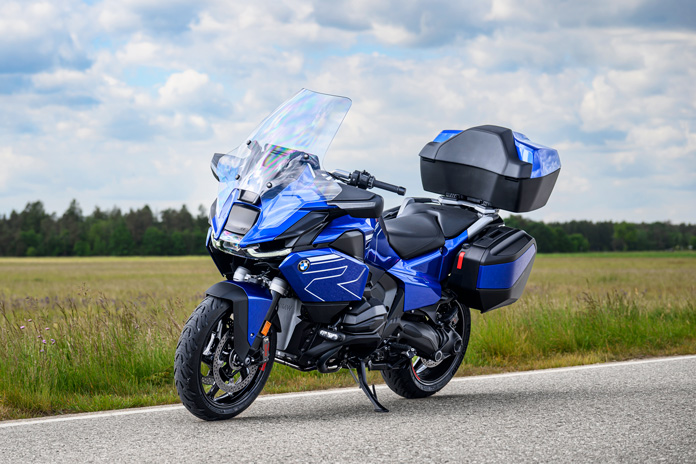
At first glance, the R 1300 RT’s silhouette is easily recognizable: the large, curved windscreen, the broad fairing, and the integrated mirrors, all designed to protect the rider and passenger from wind and rain. But it carries itself in a new way: slimmer and more muscular, modern, and purposeful.
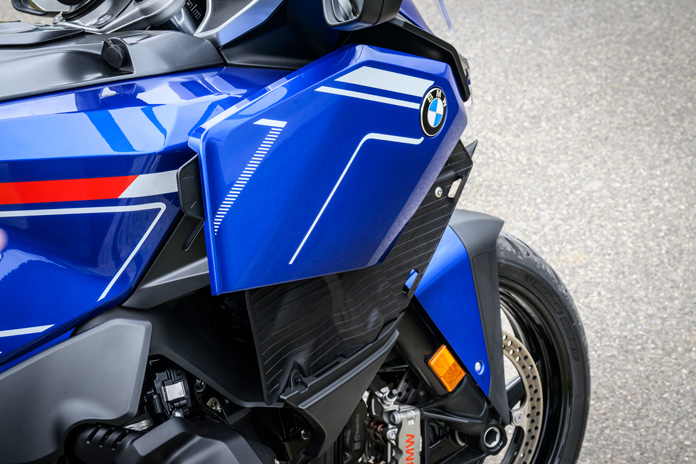
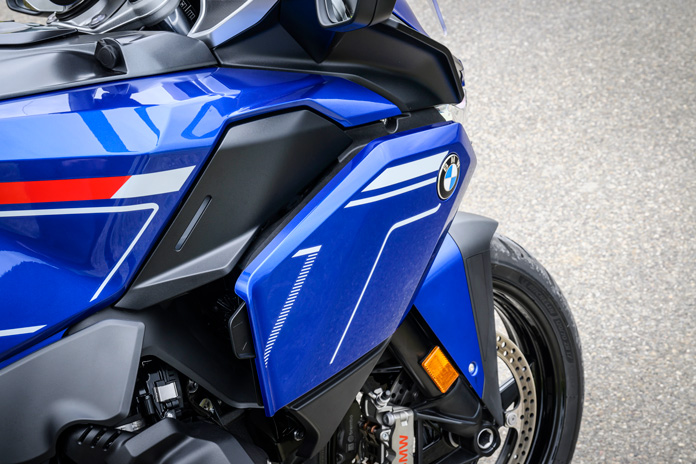
A touring bike has one job above all else: Make long days in the saddle enjoyable. The RT has long been one of the best motorcycles for burning serious miles, and the R 1300 RT is even better. Not only is its bodywork sleeker and more aerodynamic, but it’s also designed to provide more comfort for the rider. The fairing side panels slide up and down to adjust the amount of air that enters the cockpit, Variable Wind Deflectors are optional, and small cylinder fairings protect the rider’s feet. The removable saddlebags are smaller (capacity is 27 liters each, down from 35) to allow more room for the passenger’s lower legs. If you need more packing space, the optional Variable Luggage System electrically expands or contracts the bags’ width as needed, changing their capacity over a range from 27 to 33 liters.
The RT has always looked more imposing when parked than it feels when sitting in the saddle. That’s still true, and the RT is no lightweight – curb weight is 620 lb, up from 615 on the R 1250 RT – but its redesign makes it feel more compact and slender from the cockpit. Perception of size has a lot to do with seat height. To accommodate a wide range of riders, the standard seat is adjustable between 32.3 and 33.3 inches, and its tilt is adjustable. The standard seat can also be swapped for a lower (30.7/31.4 inches) or taller (33.0/33.9 inches) seat.
The ergonomic triangle was revised to position the rider farther forward while retaining the same distance between the seat and pegs. The handlebar is farther forward, wider, and less swept back, which puts the rider in a more active stance without sacrificing comfort. Putting more of the rider’s weight toward the front wheel improves handling and opens up more space for the passenger.
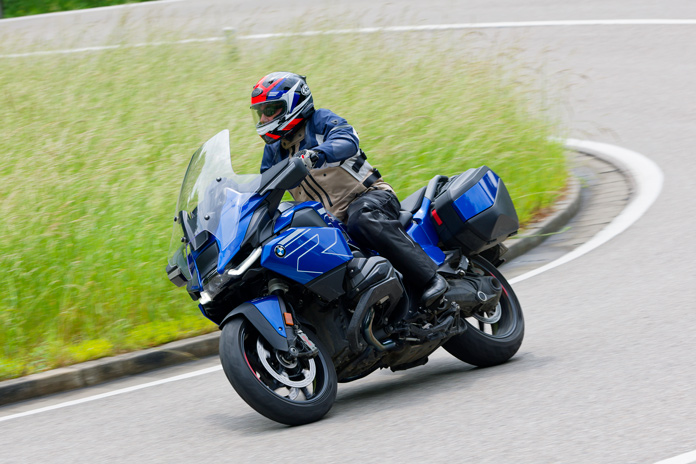
The Telelever EVO front and Paralever EVO rear suspension systems that debuted on the GS are also used on the RT, though with less wheel travel (5.9/6.2 inches vs. 7.5/7.9 inches on the GS). Semi-active Dynamic Electronic Suspension Adjustment is standard and adjusts damping, spring rate, and load automatically as conditions require. Dynamic Chassis Adjustment is a new feature that’s included with optional Ride Modes Pro. In the standard modes – Road, Rain, and Eco – DCA uses a flat steering head angle and lower ride height to maximize stability and comfort. In the Dynamic and Dynamic Pro ride modes, DCA uses firmer damping, a higher spring rate, and a higher ride height, raising the rear more than the front to shorten rake and trail for quicker steering and increased cornering clearance.
Autobahn and Beyond
Out on the road, the larger 1300 feels stronger everywhere. Whether overtaking slow-moving trucks on backroads or merging onto the autobahn, the bike responds effortlessly. The midrange punch makes passing especially easy and pulls strong to the 9,000-rpm redline.
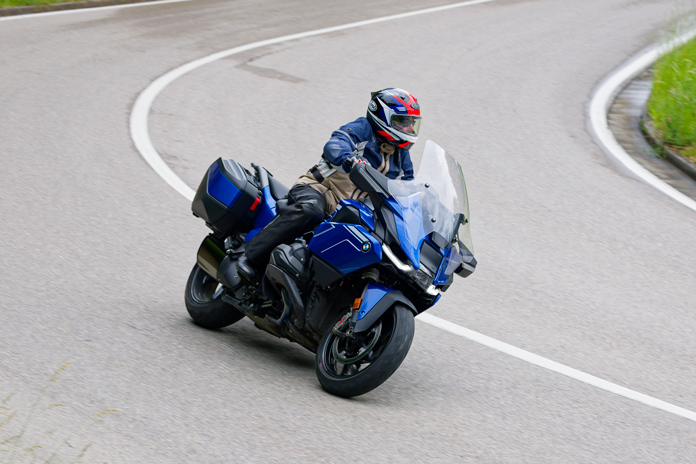
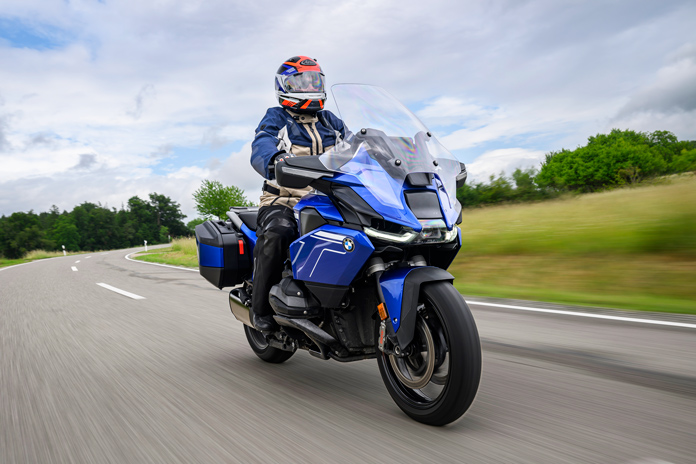
The R 1300 RT handles like a much lighter motorcycle thanks to the low center of gravity of its boxer with the gearbox mounted below the engine and new wheels that are 3 lb lighter than their predecessors. The new seating position suited my 5-foot-7 frame perfectly, and the redesigned fairing and electrically adjustable windscreen created a small nest of calm air on the highway. Even after hours on the autobahn and unfamiliar twisting backroads, I never felt stressed or uncomfortable.
Our test bikes were equipped with the optional Automated Shift Assistant, which eliminates the clutch lever but retains the foot shifter and offers fully automatic or manual shifting, with automatic shift points adjusted based on ride mode. ASA is not as seamless as it should be. It can feel clunky at low speeds, and although auto shifts are smooth, their timing isn’t always ideal.
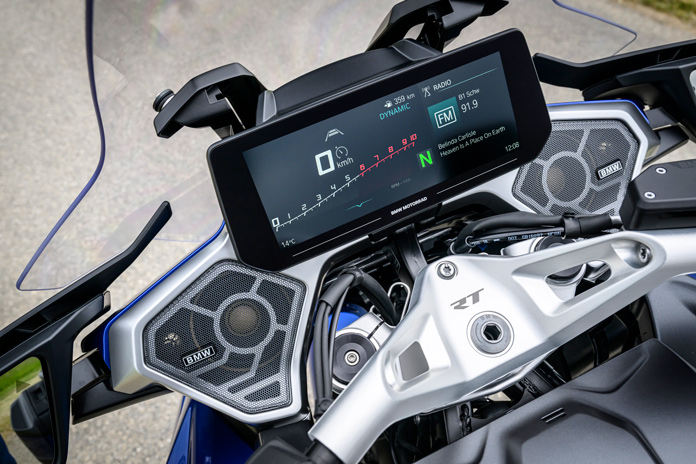
More tech abounds on the RT, though its availability depends on which options packages you buy. In addition to ASA ($935), our bikes had the Impulse Package ($7,345), which includes Ride Modes Pro, DCA, the Variable Luggage System, the adaptive Headlight Pro, radar-enabled Riding Assistant (Active Cruise Control, Front Collison Warning, and Lane Change Warning), central locking, and many more comfort and style add-ons. The RT also has a 10.25-inch TFT display offering split-screen navigation, media controls, and phone integration through BMW’s Connectivity Hub, and atop the tank is a vented storage compartment for charging a smartphone.
Touring through Germany presented a variety of microclimates and conditions, and the BMW R 1300 RT took them all in stride. Wind and weather protection were excellent, and the bike felt sure-footed and confident on wet roads – all traits we’ve come to expect from the RT.
The R 1300 RT isn’t just an update of an already-excellent touring motorcycle; it has evolved into a machine that is more than the sum of its parts. Carving along dark forest roads, gliding down the autobahn, or exploring hidden villages, it delivered all the comfort, enjoyment, and power I could ask for. The R 1250 RT was a favorite of ours and that of many sport-touring riders, and the 1300 RT takes things to the next level. It’s more refined, more capable, and more engaging – a bike that makes you want to ride farther just to see what’s around the next bend.
From city centers to scenic mountain passes, the R 1300 RT reminds us that great bikes don’t just take you places – they make the ride itself unforgettable.
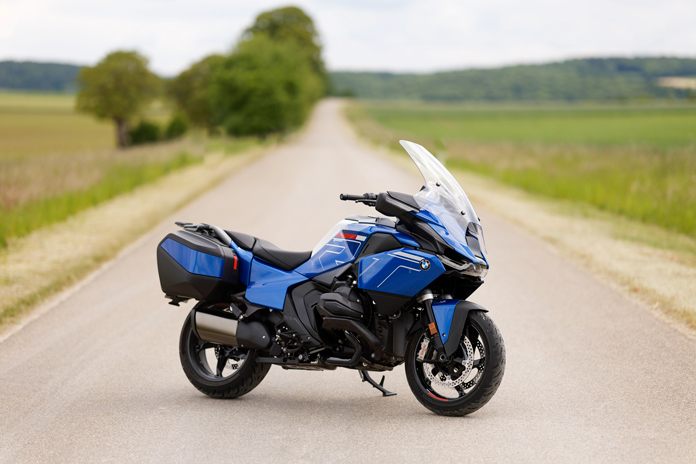
2026 BMW R 1300 RT Specs
- Base Price: $22,495
- Price as Tested: $31,525 (Impulse Package w/ Top Case Prep, Automated Shift Assistant)
- Website: BMWMotorcycles.com
- Warranty: 3 yrs., 36,000 miles
- Engine Type: Liquid‑cooled longitudinal opposed‑Twin, DOHC, 4 valves per cyl.
- Displacement: 1,300cc
- Bore x Stroke: 106.5 x 73.0mm
- Horsepower: 145 @ 7,750 rpm (factory claim)
- Torque: 110 lb‑ft @ 6,500 rpm (factory claim)
- Transmission: 6‑speed, hydraulically actuated slip/assist wet clutch
- Final Drive: Shaft
- Wheelbase: 59.0 in.
- Rake/Trail: 26 degrees/4.5 in.
- Seat Height: 30.7‑33.9 in. (low/standard/tall seats)
- Wet Weight: 620 lb (factory claim)
- Fuel Capacity: 6.3 gal.


As the former sales manager at a BMW motorcycle dealership and owner of multiple RT’s I can say from experience the engine vibrations can vary significantly from one boxer engine to another along with baseline differences between different engine years. Engine vibration isn’t mentioned in this article or most other cycle reviews which is a glaring omission in my opinion. The way a motorcycle vibrates while riding is one of the major experiences of a motorcycle and it’s omission in most reviews tends to serve the manufacturers over the potential purchasers which isn’t why we read road tests. I hope the new RT has further decreased unwanted vibration along with better consistency between different cycles of the same model.
Having owned RT’s since 1996( almost a new one each year)….my experience is that earlier twins could , and did offer ” varying degrees of vibration. That tendency did change over the life of the motor, and past the 10,000 mark they would smooth out measurable.
With the advent of the wetheads, the differences between bikes more or less vanished, and one motor felt consistent to the next.
My 2016, 18, and now 2022 are very consistent, with virtually no vibration until past 85 to 90mph.
My 22 is dead smooth at 75 to 80, with absolutely no apparent vibration intruding on riding pleasure.
Hi Cary. Thank you for sharing your thoughts. You bring up a good point and I sincerely apologize for not addressing engine vibration. While riding this new RT, I honestly didn’t feel/notice vibration at all so I didn’t think to write about the lack of it. ‘Glaring omission’ is a hard statement, and I will learn from your shared thoughts as your opinion matters to me/us, but it isn’t an omission if it’s a feeling I didn’t experience. Again, thank you for bringing this to our attention, and I will learn from this because subscribers opinions matter to all of us.
I found it interesting as I read the review that the engine is 8.3 pounds lighter, the exhaust is 14.3 pounds lighter, and the wheels are 3 pounds lighter. Assuming it is 3 pounds per wheel that is a total weight reduction of 28.6 pounds. And yet the overall weight of the bike increased by 5 pounds. I assume that can be attributed, for the most part, to the different frame used for this model. But you know what they say about assuming.
The problem with all that technology is that you wind up with a bike that costs upwards of $30k, which prices a lot of people out of the market for an RT, and makes the bikes that much more difficult and expensive to repair. On the other hand, when a new RT is introduced, a number of the folks who have to have the latest and greatest will trade their RT 1250s in, making used ones more affordable. If I were looking at a BMW, I’d be shopping an R1300R or RS, as lighter, simpler and somewhat more affordable. I don’t really need all those bells and whistles, or 145 hp, or 620 pounds to push around the garage….(I rode an R1150R for 22 years and 97,000 miles, and loved it).
The RT in my garage is 37 years old, is still going strong, and is ridden daily. It is simple, a joy to ride, is well maintained and returns the favour by looking like it’s come from the factory last month. Successive RT models are tempting but I think mine will probably outlast me.
thank goodness everyone is not like you or there would be no motorcycle industry….I bet you could afford a new RT so get out there and support the industry you obviously love
EveryThanks for pointing out that you don’t need to replace your bike with a new one every 10,000 miles. These bikes with proper maintenance will easily do 200,000 miles.
Historically at has been difficult to impossible to find a base model. I was told the 1250RT was only ordered by dealers with a pricey option package. So I had a nearly-loaded 2015 and now 2022. If you’re unfamiliar with the 2020 and later models, make sure you are OK with the navigation system, tied to a phone app and requiring map downloads, very buggy in the early years but has improved with SW updates. The phone compartment has been ventilated, but on my 2022, over about 85 degrees and in the sun, my phone still overheats, and it does not fit larger phones, or even some medium phones in a case. For 2026 it has oved to the top of the gas tank and appears larger.
A disappointing review; it sounds like something copied from a BMW brochure. Mentions effortless overtaking…was that ever a problem on the 1250 ? or the 1200 for that matter. Not much focus on handling and lean angles. How did the engine get lighter, the touring cases get smaller and the overall weight go up. The idea of smaller touring side cases is a joke on the consumer…you can get the same capacity as last year, you just have to pay extra for it. The thing looks like a small whale, we’ll see how many will pony up with $ 30k+ to ride the darn thing.
In my opinion most reviews are not reviews at all but merely verbose sales pitches! I can’t remember a single honest review in the last 30 years. It’s always the same thing, “buy this and you’ll have the greatest machine ever”. I’ve owned several bmw’s and they are fine machines but they just keep getting fatter and way too expensive. Not worth the money in my opinion.
Bud/Fred: Thank you both for taking the time to share your thoughts with us. You both mention similar thoughts regarding my review as being like ‘BMW sales pitches/brochures’, and I am glad you shared your opinions. Please note this was not my intention at all, but now that I read your thoughts and then re-read my review, I can see your points. Riding and reviewing new motorcycles is both fun and exhilarating, and as a 2015 BMW 1200 GS owner, I can see how my enthusiasm and excitement of riding these new BMW’s in Germany had me focused on all the positives of my experiences and not the negatives. But to question my honesty is unjust and to say ‘It’s always the same thing’ is incorrect. All of us here at Rider take pride in sharing our personal experiences to help our subscribers learn about new bikes, accessories, gear, and moto destinations. Looking for and then stating negatives just to ‘appear’ fair would take us into unchartered territories, and that it not right either. For over 51 years, we have published opinions that motorcyclists rely on because we take pride in being honest, sincere, and trustworthy. This is a fact. With this, I stand by my shared experiences because it is how I experienced these new motorcycles. I had outstanding experiences riding them and so I reported on my own experiences, just as you would if you rode them and reviewed them. I will learn from your shared thoughts, and I appreciate you both sharing them with us, because your opinions are important to us, just as all subscribers’ opinions are important to us. In future reviews, I will keep your thoughts in mind, so I am glad you shared this with us. Thank you!
I believe you when you say you are honestly sharing your experiences. Problem is that the MFG demos are set up to give the reviewer the best possible experience and leave them with an overall positive impression. You also don’t get to put on enough miles to get to the niggles.
Thank you for your impressions, but it will be good to see some long term reviews.
Hopefully the looks will grow on you, but the 1300 is one seriously UGLY bike. But my ’07 RT looked ugly and grew on me and my ’15 RT was no better. Still not sure I like its looks after 90k miles.
Just finished a 6,000 mile trip from CA to MI, around the Great Lakes and back home. Many overcast/rainy days, highs in the low 50s. The BMW RT just eats up the miles; any road from twisty to muddy construction zones. 300 mile range, 50+ mpg through any condition. 80 mph interstate to two-lane backroad. Two finger braking, easy handling. I’d still be out there but I wasted the front tire in the mountains coming home.
Price as Tested: $31,525
This should have been the first line in this glowing review. I agree the bike is impressive, but remember:
Price as Tested: $31,525
Does that include freight and shipping?
Text says redline is at 9000 RPM, but photo of dash shows redline as 6000 RPM. That photo value is more likely for a touring sport/touring model.
Redline is 9,000 rpm. The engine makes peak horsepower (145) at 7,750 rpm, so redline can’t be 6,000 rpm. The R 1300 RT has a TFT digital display, and the change in color on the tachometer, even though it looks like redline, is likely a shift point.
At start-up the redline is reduced until the engine is warmed up.
Ah, that makes sense!
On a ‘21 RT when first starting the bike it shows a lower redline for a short period of time. I’ve never timed it, but seems like it increases by 1k every minute until warm. Also, it’s covered in the owners manual.
Sold my 2025 GSA with the same engine. Between 2500-4500 rpms the mechanical clatter made the engine sound broken. I was told it’s normal for the 1300 engines. Mine was terrible. And yes I’ve owned air cooled 1200’s and water cooled 1200’s and 1250’s and while they were “agricultural” none of them made this awful ticking/clattering sound. Not sure if the engine casings are thinner or it’s the internal design of the motor but I’d suggest a test ride before ordering one.
$31,525 – wow!
Although well made, BMW’s are simply overpriced.
I’m on my second RT. The first was a 2004 and my current one is a 2020 and I had a 2011 GS in between. The new one has tempted me but as others have said, at $30K+ things like luggage capacity should at least equal the earlier bike. By the time you pay for the larger bags (that are still smaller than the 1250) and add a top trunk, you’ll be nearing $35K.
I’ll likely keep the 2020.