
Like many of you, my weekdays are spent in the office and my riding is done on the weekends. Flying off to Europe to ride a brand-new motorcycle before it’s available in dealerships is a rare experience for me. Luckily, I know a guy (my brother, Greg, is Rider’s editor-in-chief). A couple years ago he sent me to Alicante, Spain, for a first ride on Triumph’s Daytona 660. The Daytona was well-sorted and confidence inspiring, and it made carving up twisty Spanish roads an absolute delight.
I used to live in Spain, I speak Spanish fluently, and I love Spanish food, wine, and culture. Last summer, my wife, our two kids, and I spent a month traveling around Spain. I can’t get enough of the place. So when Greg asked if I wanted to go back to Alicante to ride the updated Trident 660 and Tiger Sport 660, I had my bags packed before we got off the phone.
Nice Package(s)
Triumph knows how to throw a press launch. Southern Spain is often a destination of choice because it typically has mild, dry weather during winter and early spring and its roads are nothing short of fantastic. We arrived at a large resort within sight of the Mediterranean to find Triumph banners and gleaming motorcycles parked at strategic locations around the hotel, including near the registration desk in the lobby.
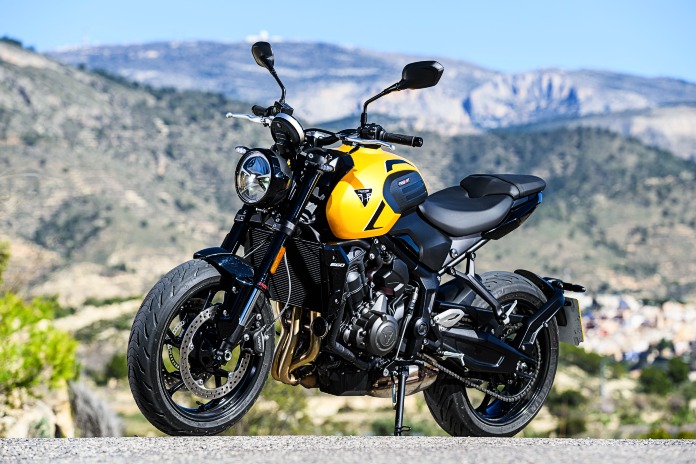
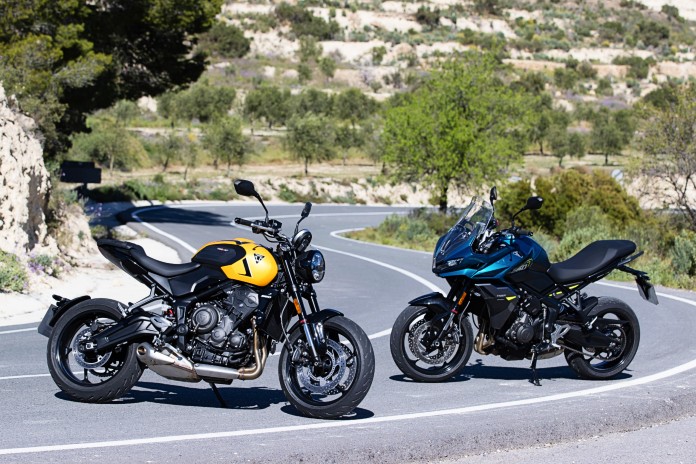
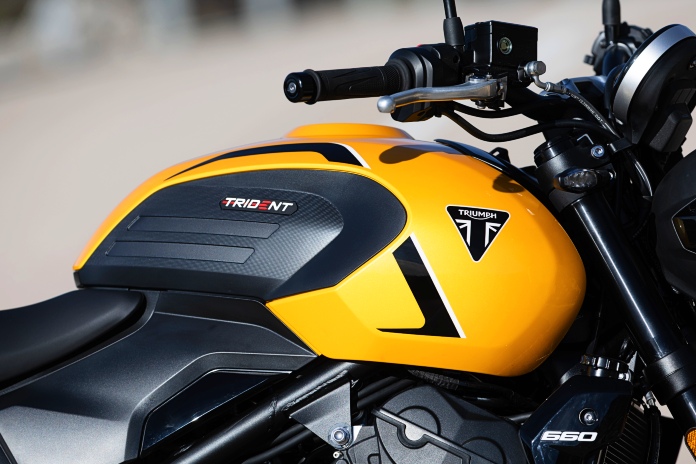
I was bone-tired from the flight, but not too bone-tired to take a few minutes to admire the Trident roadster and the Tiger Sport, its sport-touring sibling. The Trident in Cosmic Yellow looks bloody brilliant, as our British hosts would say. The only splash of color is on the gas tank, which has eye-grabbing, angular knee cut-outs in contrasting black and a swooping black-and-white accent stripe. Some of today’s motorcycles look like the design team’s AutoCad got stuck in Acute Angle Mode. Not so with the Trident. It strikes a balance between thoroughly modern (swingarm, silencers, that tank!) and pleasingly retro (headlight, gauges, mirrors).
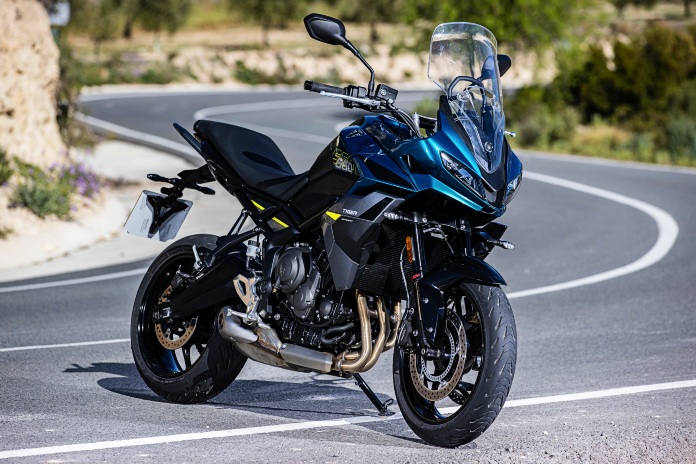
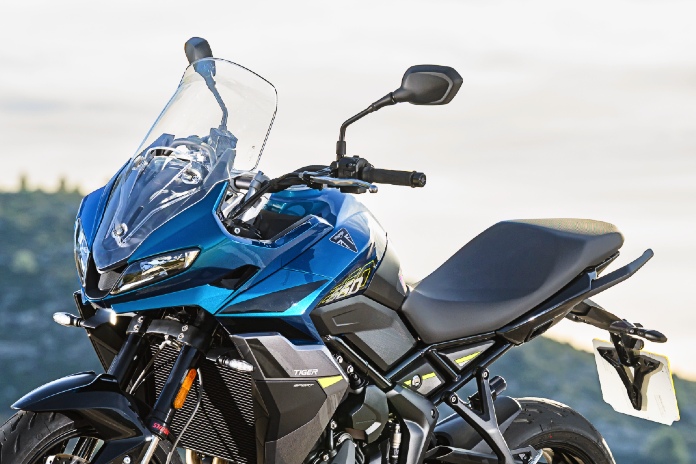
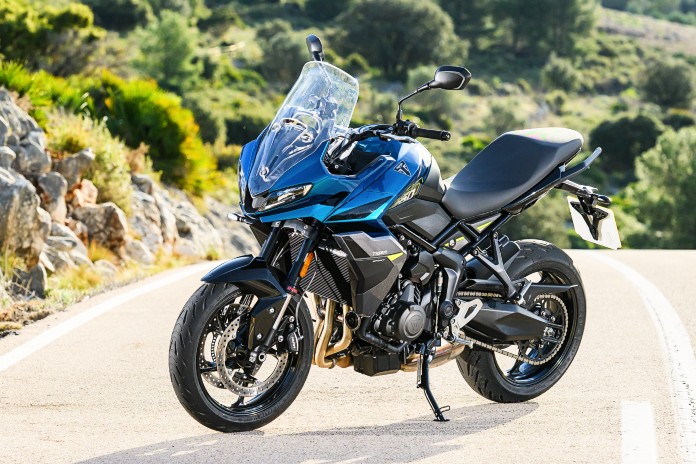
The Tiger Sport cuts a more utilitarian figure. Don’t get me wrong, the bike will turn heads. Just look at the way the radiator cowls pop in the Silver Ice/Intense Orange colorway. Again, the bright color is limited to a small part of the bike, making it stand out even more. The updated bodywork improves wind protection and splits the difference visually between “sport” and “tourer.”
Both bikes are eye-catching in their own way, and even though they’re built on the same platform, each has a unique personality. Sort of like Greg and me. We have the same parents and grew up in the same household, but we march to different drummers.
Tarted-up Triple
The overnight flight from Los Angeles deprived me of a good night’s sleep, so once in Spain I crashed hard. After a day spent checking out Alicante, I was ready for the evening’s technical presentation. Triumph’s engineering team, led by Stuart Wood, had a lot to brag about. The 660cc inline-Triple powering both bikes makes an additional 14 hp (up 18%) and 4 lb-ft of torque (up 9%) compared to the previous version. Peak output is now 94 hp at 11,250 rpm (1,000 rpm higher than before) and 51.1 lb-ft at 8,250 rpm (2,000 rpm higher), and redline is increased to 12,650 rpm. Horsepower may be the fast-running hare, but torque is the tortoise that wins the race in terms of usability. Triumph says 80% of peak torque is available throughout the rev range.
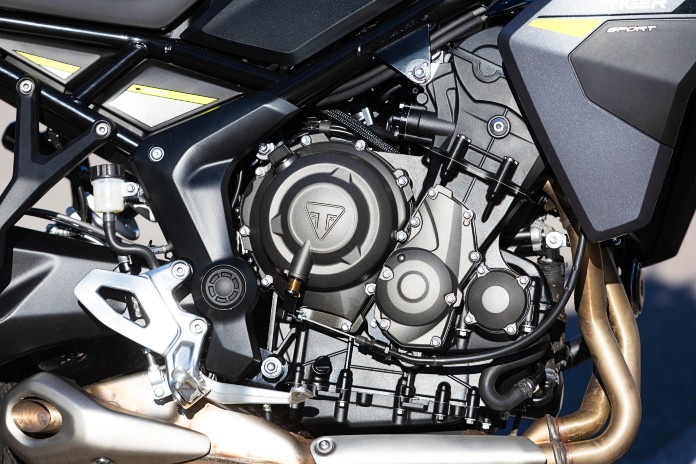
How did Triumph squeeze so much more oomph out of the engine without increasing displacement by a single cubic centimeter? There are now three throttle bodies instead of just one, the airbox is bigger, and the cylinder head has larger exhaust valves and a higher-lift cam profile. Triumph also recalibrated the throttle-by-wire for smoother low-rpm throttle openings and better overall response. On that count, I’d say they nailed it. The right grip meters out power in a precise, linear manner. Smooth, sweet, and delicious, like grandma’s buttercream frosting.
After the tech talk, we got a preview of the next day’s route, the map showing a particularly squiggly line looping through mountainous terrain. Having ridden this area before, I knew I was in for sweepers, hairpins, chicanes, and elevation changes, sometimes all within a mile of one another. I needed to be firing on all cylinders, so I avoided overindulging in vino tinto and retired early.
Tiger Sport 660
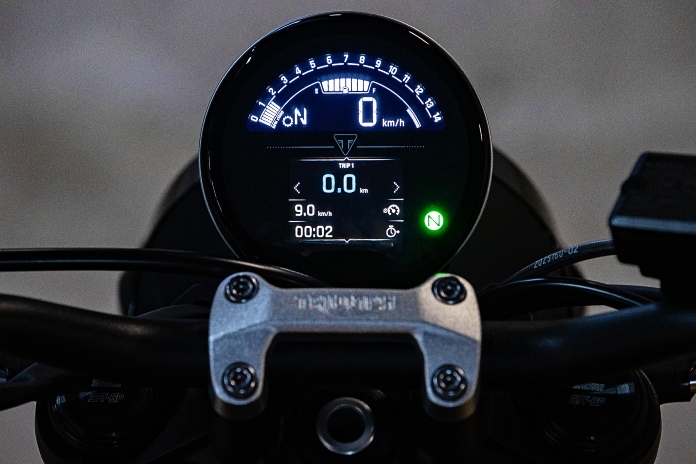
The next morning, I was given the key to a Tiger Sport 660 in Interstellar Blue/Mineral Gray, with the fetching blue applied to the upper fairing and top of the tank. I arrived a little early so I could familiarize myself with the instrument setup. There’s a color TFT display on top paired with an LCD screen below; both were easy to read, and the interface was intuitive. There’s just the right amount of tech on this bike without making it unnecessarily complex (or expensive). The bike offers three ride modes: Sport, Road, and Rain. A 6-axis IMU provides inputs for cornering ABS and traction control, and the quickshifter and one-touch cruise control are standard.
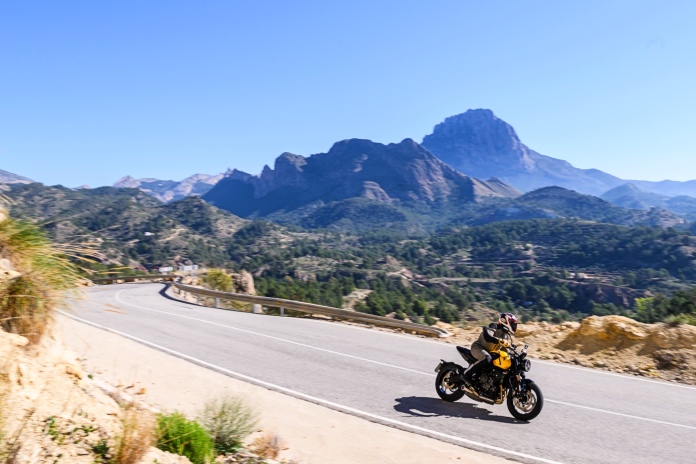
Ready to twist the Tiger’s tail, I put it in Sport mode, and we headed for the hills by way of lots of urban roundabouts. The updated 3-into-1 exhaust system produces more of a growl than a bark. You’ll hear those three cylinders, but your neighbors won’t complain. The 660’s wide powerband combined with clutchless up- and downshifting made short work of getting through villages and around pokey cars, and the steering geometry made for a nimble-but-not-twitchy ride.
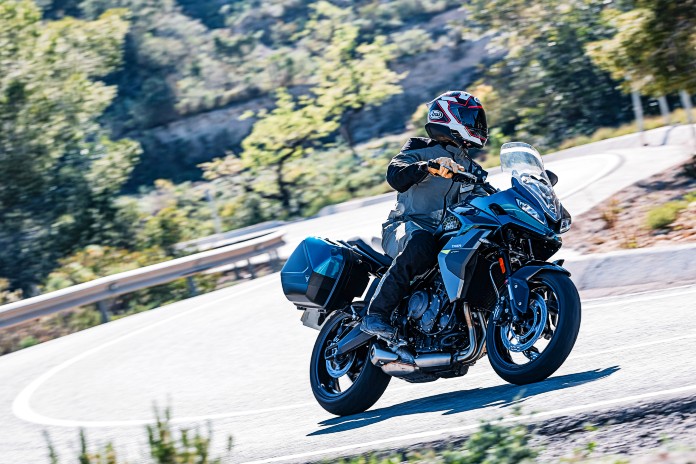
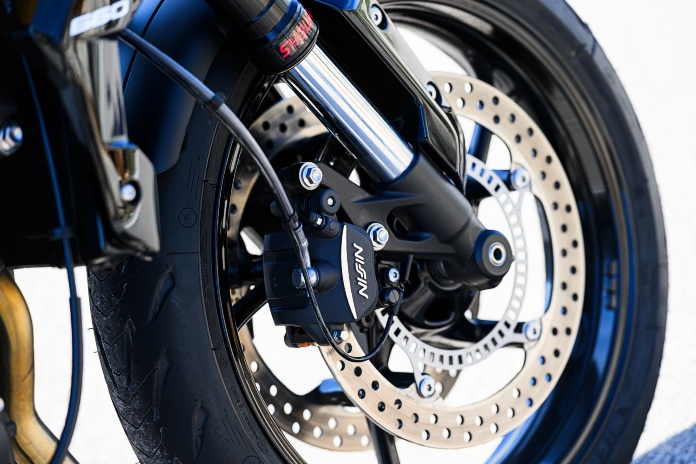
As we gained elevation, traffic thinned out and we found ourselves on a silky-smooth road winding through pines and rocky knolls. The Tiger’s throttle response was always spot-on, and power delivery was consistent with no dips or flat spots. The Triple’s 94 horses pushed the bike through corners as fast as I wanted without needing to pin the throttle. Up front, twin 310mm discs are pinched by Nissin 2-piston calipers, and fluid is pushed through steel-braided lines. Braking power was good without requiring me to mash the lever. Entering and exiting corners, the Showa separate-function inverted fork and rear monoshock performed competently (the only adjustment is rear preload via remote knob).
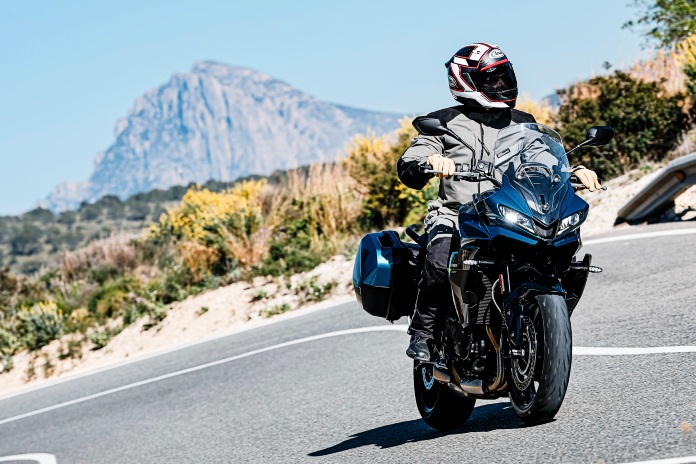
The Tiger’s upright riding position was comfortable enough for all-day riding, and the ergonomics felt agreeable whether I was pushing it through curves or cruising at mellow speeds. The fairing and one-hand-adjustable windscreen provided plenty of wind protection in higher-speed straightaways and sweepers. The 32.9-inch seat height kept my knees from complaining (a lower 31.9-inch seat is available as an accessory).
GEAR UP
- Helmet: Arai Contour-X
- Suit: Aerostich R-3 One-Piece
- Airbag Vest: Alpinestars Tech-Air 5 Plasma
- Gloves: Aerostich Elkskin Roper 2.0
- Boots: Cortech Apex RR WP
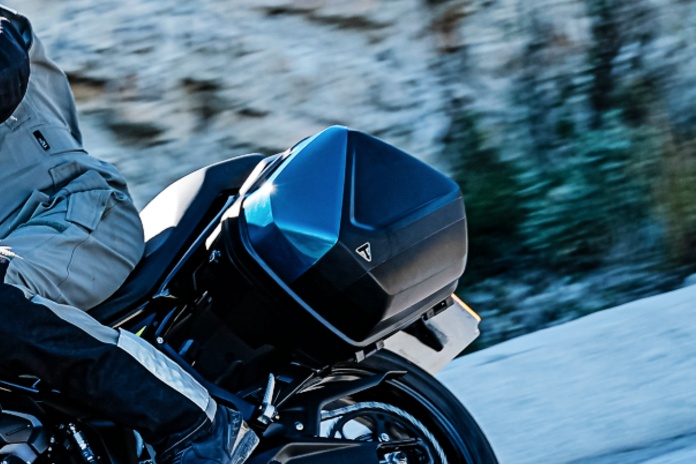
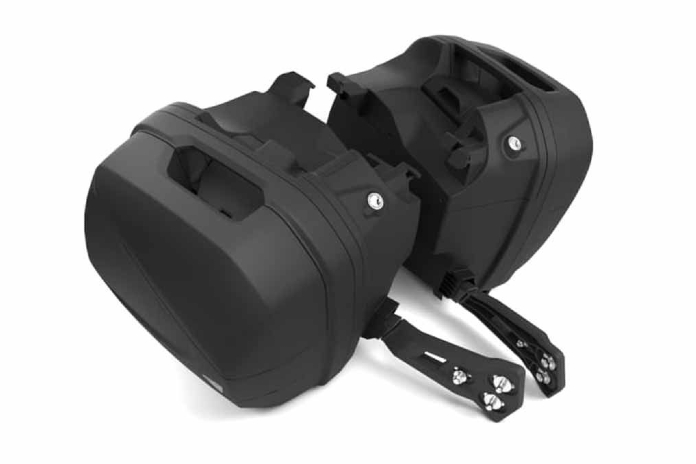
The Tiger Sport 660 that I rode in Spain was equipped with the optional color-matched side cases ($970). The mounting system is discreetly built into the tailsection, which remains clutter-free when the cases are removed, and the locks are matched to the ignition key. The capacity of each pannier is 28.5 liters, enough to hold an XL helmet in either side. A color-matched 47-liter top box that holds two XL helmets is also available ($490; luggage rack required, $185), along with heated grips, handguards, and more.
After a morning chasing other riders up into the mountains with the Tiger Sport, we stopped at the village of Busot and ate lunch al aire libre in the town square before swapping bikes for the afternoon session.
Trident 660
Naked bikes make me feel like Major Kong riding the bomb in Dr. Strangelove: I’m ready to go fast and hoot and holler, so I was excited about riding the Trident. Compared to the Tiger Sport, it is lighter (430 lb vs 465) and the wheelbase is shorter, differences I felt immediately while laying it over through a series of turns.
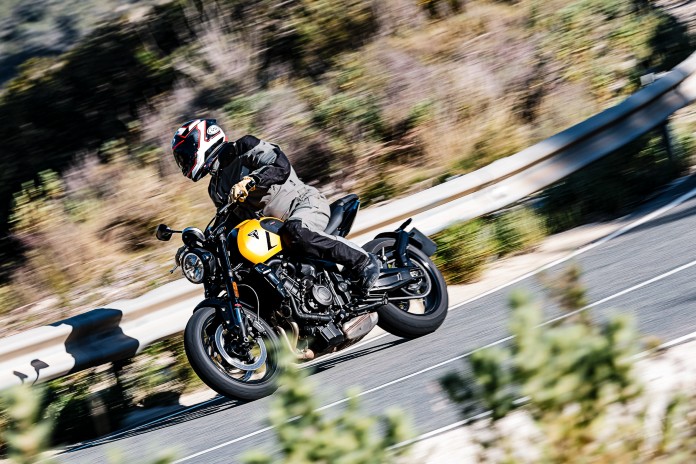
Given its sportier mission, the Trident has slightly higher-spec Showa suspension than the Tiger: an inverted big-piston fork and a rear shock that offers rebound adjustment in addition to preload. Like the Tiger, the Trident’s cast-aluminum wheels are shod with Michelin Road 5 tires, which are good all-around road rubber offering consistent grip and neutral handling.
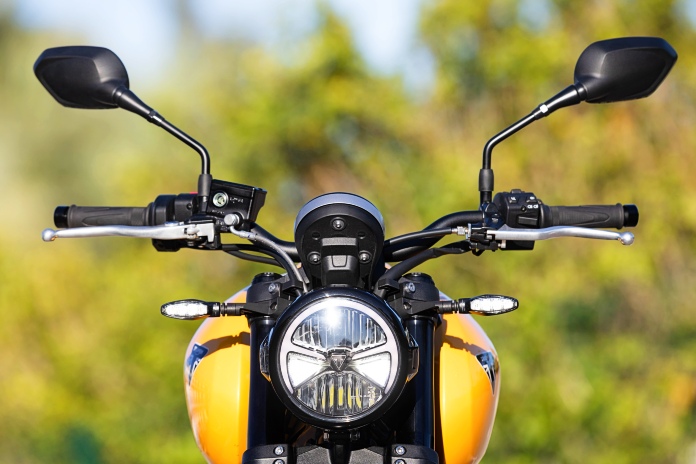
The Trident’s narrower, lower handlebar, higher footpegs, and lower seat (31.9 inches) give it a more compact riding position than the Tiger Sport. The Trident’s extra flickability and lack of fairing made me feel like I was going faster than I had on the Tiger, and it seemed to transfer the 660 engine’s 94 horses to the pavement (and my adrenal glands) with less resistance.
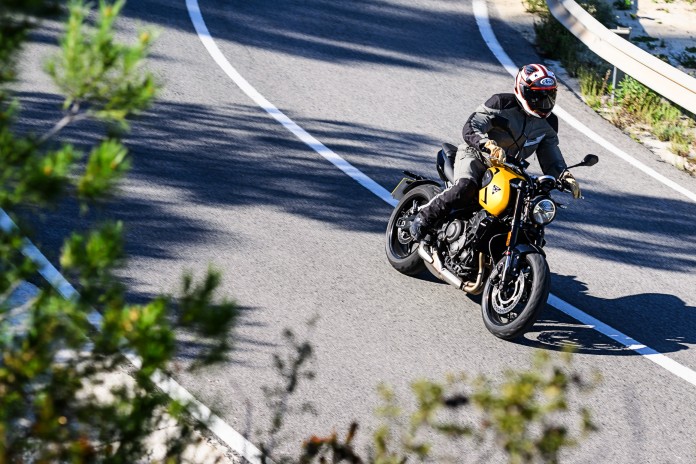
If you want to spice up the Trident, it can be accessorized with a color-matched flyscreen, a bellypan, bar-end mirrors, and other stylish upgrades.
Which One?
If I had to choose between the two, I’d go with the Tiger Sport. Yes, the Trident is sportier, more visceral, and looks mean enough to beat you up for your lunch money, but the more aggressive ergonomics and lack of wind protection make it less comfortable for longer rides. What can I say? I’m in my mid-50s, and practicality weighs heavier on the scale than it once did. With the same engine and mostly the same chassis, the Tiger Sport can play double duty as a Sunday canyon carver and a long-weekend traveler.

With larger, more expensive Tigers and Tridents in the lineup, Triumph positions these two as entry-level options, with the Trident 660 priced at $8,745 and the Tiger Sport 660 at $10,445. Both look and perform like more expensive machines, and they’re well-equipped with things like MyTriumph connectivity (navigation, music, and call control), self-canceling turnsignals, a slip/assist clutch, and adjustable levers. Plus, the cost of ownership is kept low with 10,000-mile service intervals.
After riding the Tiger Sport and the Trident, I found myself thinking about flow state, that pleasurable zone of intense focus where you lose yourself in what you are doing, and time passes unnoticed. I’m no expert, but I know that if I’m distracted by how my equipment is performing, it ain’t happening. The Trident and the Tiger Sport both perform superbly, and the attention to detail that Triumph put into both allowed me to enjoy the ride and not think about anything but the next curve ahead.
Check out more new bikes in Rider’s 2026 Motorcycle Buyers Guide
2026 Triumph Tiger Sport 660 / Trident 660 Specs
- Base Price: $10,445 / $8,745
- Website: TriumphMotorcycles.com
- Warranty: 2 yrs., unltd. miles
- Engine Type: Liquid-cooled, transverse inline-Triple, DOHC w/ 4 valves per cyl.
- Displacement: 660cc
- Bore x Stroke: 74 x 51.1mm
- Horsepower: 94 hp @ 11,250 rpm (factory claim)
- Torque: 50.2 lb-ft @ 8,250 rpm (factory claim)
- Transmission: 6-speed, cable-actuated slip/assist wet clutch
- Final Drive: Chain
- Wheelbase: 55.3 in. / 54.7 in.
- Rake/Trail: 23.1 degrees/3.8 in. / 24.5 degrees/4.25 in.
- Seat Height: 32.9 in. / 31.9 in.
- Wet Weight: 465 lb / 430 lb (factory claim)
- Fuel Capacity: 4.9 gal. / 3.7 gal.
- Fuel Consumption: 44.1 mpg / 44.8 mpg (EPA estimate)
- Estimated Range: 216 miles / 166 miles

Paul Drevenstedt’s first motorcycle was a rat-trap BMW R90S that he pushed as much as he rode. He lives in Ventura, California, with his wife, two young children, two fish, a poodle mix, and a hamster.



Nice bike but using the Tiger name for a non-adventure bike makes it kind of confusing. Tiger Sport is not a good name either way.
The CFMOTO 675NK has the same power setup, for $3K less. The Tiger Sport seems to have extras but I’m not sure it’s THAT much more for the price.