

Twenty-five years later, hundreds of motorcyclists continue a journey connecting the three sites of September 11th and honoring the people America promised never to forget.
I was supposed to be riding near the front of America’s 9/11 Ride this year, alongside founders Ted and Lisa Sjurseth; Keith Costanzo, my best friend since we were little kids growing up in Oradell, New Jersey; his colleague from The Blue Knights International Law Enforcement Motorcycle Club; ride leadership; police motor officers; and hundreds of fellow motorcyclists gathering in Somerset, Pennsylvania. I had been invited to participate as a VIP and planned to cover the experience for Rider from the perspective I know best: behind the handlebar. From Somerset, we would travel to the Flight 93 National Memorial, continue to the Pentagon, and ultimately make our way to New York City, connecting the three places forever linked by September 11, 2001.
A car accident in my wife’s Alfa Romeo shortly before the ride made that impossible. I was deeply disappointed, but it didn’t take long to put my disappointment into perspective. Thousands of people left their homes on an ordinary Tuesday morning 25 years ago and never returned. Their families didn’t lose a motorcycle trip or an experience they had been looking forward to. They lost husbands and wives, mothers and fathers, sons and daughters, brothers and sisters, friends and co-workers.
There was also a personal reason I wanted to approach this story carefully. One of the people killed in the World Trade Center was someone I had gone to high school with. Behind her name is a family and friends that have lived with her absence for 25 years. I wanted to honor her memory, and theirs, without making their loss part of my story. I have long believed that one of the best ways to honor people is to carry something good forward, and that became an important guide for how I approached this assignment.
So instead of reporting what I would have seen from behind my BMW R1200GS windscreen, I researched, asked questions, and listened. I listened to Ted and Lisa, to people who have made this journey, to the first responders and volunteers who make it possible, and to the communities that have lined the route year after year. Then, as the 2026 ride unfolded, I followed what was happening from a distance. Reports from along the route provided something that wasn’t available when I began researching this story: another chapter of the journey itself.
Riders dealt with rain as they traveled toward Somerset and the Flight 93 National Memorial. The procession continued through Pennsylvania toward Virginia, where communities prepared for its arrival. Police officers managed intersections and escorted the motorcycles across jurisdictions, while firefighters, veterans, families and other residents gathered along portions of the route. The motorcycles eventually turned north toward New Jersey and New York, completing the journey that Sunday.
I wasn’t among them, so I won’t tell you what it felt like. What I can tell you is why they were there.
The more I learned, the more I understood that this isn’t really a story about hundreds of motorcycles traveling hundreds of miles. The motorcycles are what bring everyone together. The story is about why, a quarter century after September 11, people continue making this journey, and why people who don’t ride continue showing up along the way.
Remembering People, Not Numbers
September 11 is inevitably remembered through numbers: four airplanes, three attack sites, two towers and 2,977 people killed in the terrorist attacks, including first responders who lost their lives while answering calls for help. Numbers help us comprehend the scale of what happened, but they can also distance us from the lives behind them. Nobody received a telephone call that morning telling them they had lost a statistic. They had lost someone they loved.
The people whose lives were taken woke up expecting an ordinary day. They made coffee, got dressed for work, dropped their children off, caught trains, boarded airplanes and kissed people goodbye expecting to see them again. Firefighters, police officers, EMTs and other first responders reported for another shift. Within hours, thousands of families had been changed forever.
Those families have since lived through 25 years of birthdays, graduations, weddings, holidays and countless ordinary days when someone should have been there but wasn’t. Children grew into adults without a parent. Parents grew older without a son or daughter. Grandchildren know someone they never met through photographs, stories and the memories other people have carried forward for them.
Ted and Lisa have met many of those families during the life of the Foundation. Ted remembers a survivor who was on the 37th floor of Tower Two, and who has spoken to the riders in New York. When that man speaks, Ted says the crowd becomes so quiet “you can hear a pin drop.” Hundreds of people who have spent days surrounded by motorcycles, police sirens, wind and road noise suddenly stand together and listen, because they aren’t hearing history explained to them… They are hearing it from someone who lived it.
That distinction becomes more important with every passing year. America’s 9/11 Ride insists on it, asking riders and the people watching them pass to remember that every one of those numbers had a name, and every name belonged to someone.
For readers who want to move beyond the number 2,977 and learn the individual names being remembered, the National September 11 Memorial & Museum maintains an online record of the nearly 3,000 names as they are inscribed in bronze on the Memorial, including the location of each name:
How a Motorcycle Vacation Became a Mission
America’s 9/11 Ride was never part of a long-term plan. When Brendan Baker, Editor-In-Chief of Powersports Business, asked Ted whether he had intended to start a foundation and annual motorcycle ride, his answer was an immediate: “Lord, no.”
Ted and Lisa had participated in the Trail of Tears Commemorative Motorcycle Ride in 2000 and planned another journey for 2001, beginning in Cherokee, North Carolina, and continuing toward Oklahoma. They were scheduled to leave September 12. Then September 11 changed everything.
Ted, who was working as a government consultant, was told nobody was going anywhere. At home, their children were asking questions while Lisa watched the news. In the middle of the uncertainty, she asked Ted a simple question: Why not organize a motorcycle ride to New York and raise money to help?
Ted began contacting radio stations and Harley-Davidson dealers, and his younger brother suggested hosting the ride on November 10 and 11, Veterans Day weekend. On November 10, at approximately 8:00 in the morning, riders left from in front of the White House in temperatures around 25 degrees Farenheit. Approximately 350 people aboard 250 motorcycles participated, including Senator Ben Nighthorse Campbell, a Navy admiral, along with members of his entourage. There was no massive police escort, elaborate support infrastructure or sophisticated logistical operation. They were simply trying to get from Washington, D.C. to New York and do something meaningful.
The ride began growing before they had even reached their destination. Ted remembers stopping in Delaware for hot dogs and having people ask what they were doing. When the riders explained where they were going and why, people wanted to join them, so they did. Two months to the day after the attacks, the growing group arrived in New York and placed 1,000 roses at Trinity Church near Ground Zero.
Afterward, Ted and Lisa began hearing the same message from people who had participated: “You gotta do it again.” When they returned to New York for New Year’s Eve, police officers recognized them and thanked them for supporting the city. Ted had barely been to New York before, yet officers there knew who they were and what those riders had done. For him, that mattered.
By 2002, police support had been added, Somerset had become part of the journey, and a route connecting the three sites was taking shape. What began as a response to one terrible day gradually became America’s 9/11 Foundation and America’s 9/11 Ride. Twenty-five years later, the fact that none of it was originally supposed to exist may be one of the most revealing parts of its story. Ted and Lisa didn’t begin with an organization, strategic plan or expectation that thousands of motorcyclists would eventually follow them. They saw people hurting and decided to act.
Why They Ride in August
There is a deeply respectful reason America’s 9/11 Ride takes place in August rather than September. After the first ride, Ted met with New York City’s police chief and was told not to bring the event into the city around September 11. Ted agreed because he didn’t want hundreds of motorcycles interfering with families trying to reach the site to remember the people they had lost.
That decision says a great deal about the Foundation and how the riders fit into this story. The ride exists to honor those families, not intrude upon their remembrance. Establishing its traditional place in August gave motorcyclists an opportunity to pay their respects while leaving September 11 itself to families, survivors, first responders and others for whom the anniversary remains profoundly personal.
There is an obvious spectacle when hundreds of motorcycles are moving together under police escort, particularly when highways and city streets are temporarily cleared for them. But spectacle cannot become the purpose. The motorcycles are there because they attract attention to something more important than themselves.
What It Takes to Move a Memorial
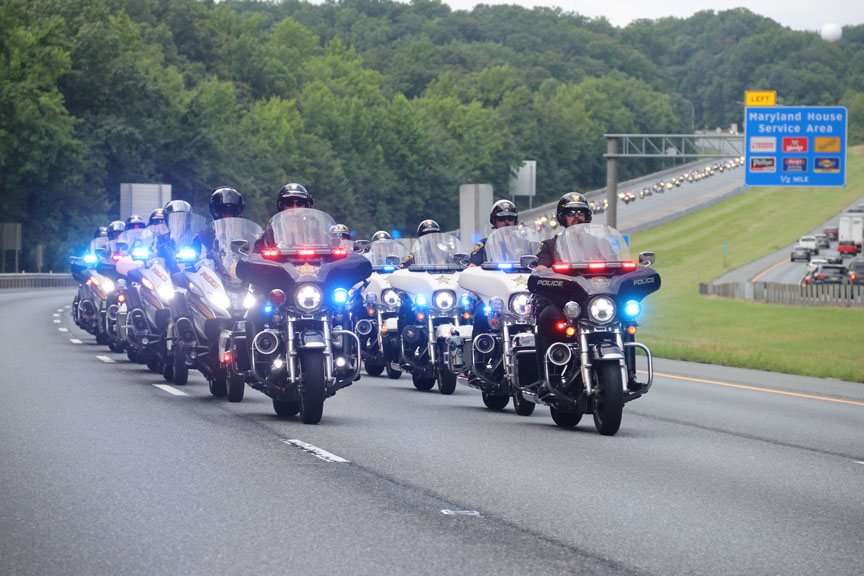
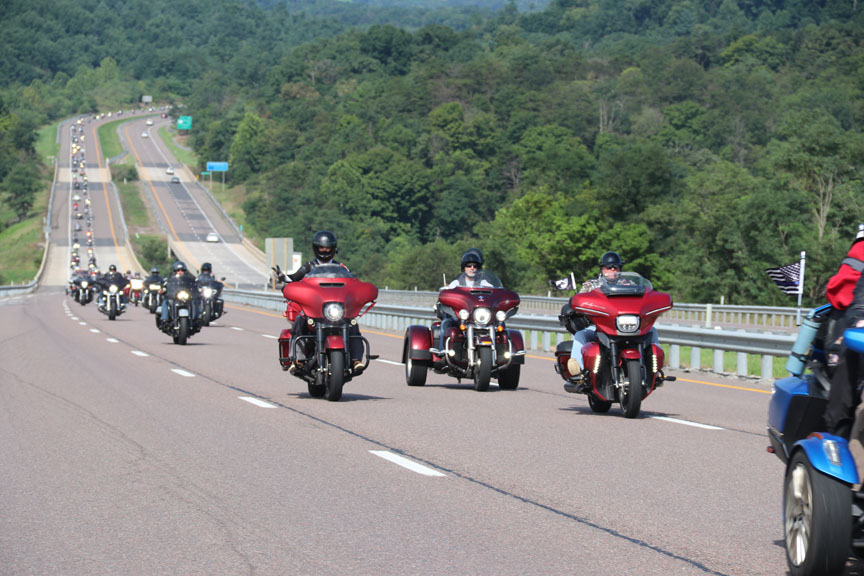
The 2026 journey carried additional significance because it occurred during the 25th anniversary of the attacks. Organizers anticipated roughly 700 motorcycles for the multiday ride connecting the Flight 93 National Memorial, the Pentagon and the World Trade Center site. Moving anything approaching that number of motorcycles across several states while maintaining arrival times, fuel stops, meals, police coordination, emergency response and mechanical support is an enormous logistical exercise.
Two riders can travel comfortably at highway speeds. Add hundreds and everything changes. The Foundation has spent a quarter century learning how to keep that many motorcycles together, moving and safe.
One example is what Ted calls the “Pumper Team.” Instead of hundreds of riders dismounting, unlocking gas caps and operating pumps individually, volunteers staff the pumps and fuel the motorcycles. Riders round the cost up to the next dollar, with the additional money helping offset ambulance expenses. The Foundation brings medical support and even its own fire truck. Depending on the year, Ted says the police escort has ranged from approximately 85 to 225 motor officers, some traveling from as far as El Paso, Texas..
When motorcycles break down, participating dealerships have stayed open late to repair them. Support crews have transported machines to dealerships, retrieved them later and, in extreme cases, carried riders and motorcycles all the way to New York and back toward home. Ted remembers one motorcycle breaking down inside a Baltimore tunnel and being removed in four and a half minutes.
For a ride honoring first responders, there is something particularly appropriate about that philosophy. When somebody needs help, you don’t ride past.
Somerset and Flight 93
The experience becomes more personal in Somerset, where riders travel through Pennsylvania’s mountains, farmland and pastures toward the Flight 93 National Memorial. In 2026, riders also dealt with hours of rain as they made their way through the opening portion of the journey.
Anyone who has traveled any distance on a motorcycle understands what riding in the rain for hours means: reduced visibility, wet gloves, water finding its way into places you thought were sealed, increased concentration and the simple desire to eventually become dry again. But turning the weather into a story about motorcycle toughness would miss what brought these riders to Pennsylvania. They weren’t riding through rain to prove they could. They were trying to get somewhere.
Ahead was a landscape unlike the other two places associated with September 11. There is no Manhattan skyline or Pentagon atthe Flight 93 site, only open Pennsylvania countryside where the passengers and crew aboard United Airlines Flight 93 learned that other hijacked aircraft had been used as weapons and made the decision to fight back. Their airplane never reached its intended target. All 40 passengers and crew members were killed when it crashed near Shanksville.
There is an unavoidable contrast between hundreds of motorcycles arriving together and the quiet place they have come to honor. The engines shut off, riders dismount, and people who have spent hours concentrating on the road are asked to stand still and consider why they came.
The Foundation has honored all three sites in another remarkable way. In 2009, the National Park Service, New York City, the World Trade Center site and the Pentagon allowed the Foundation to fly 100 full-size burial flags at the three locations on September 11. Ted and Lisa began in New York around 1am, traveled to the Pentagon and continued to Somerset, where the flags were flown in drizzling rain after dark. Everyone handling them wore white linen gloves, and the flags were later taken to members of the Old Guard at Arlington National Cemetery to be properly folded.
The story helps explain the tone Ted and Lisa have tried to maintain. Remembrance, in their hands, has never required spectacle. Sometimes it requires people quietly doing something because they believe it matters.
What America Remembers Along the Road
Ask Ted what makes the ride special and he eventually starts talking about places such as Cumberland, Maryland; Leesburg, Virginia; and Hightstown, New Jersey. He knows where first responders will position equipment and where families and children will appear, because many of these communities have been doing it for years.
The 2026 journey offered a fresh demonstration. Leesburg placed America’s 9/11 Ride on its official town calendar for the afternoon of August 21, setting aside time for the procession’s passage through the community. That seemingly ordinary municipal-calendar entry says something important about a ride that has returned to many of these places year after year: the communities know it is coming, and people prepare to meet it.
Fire departments position equipment along portions of the route. Firefighters, police officers and EMTs stand at attention. Veterans salute. Families wave American flags. Parents bring children. People gather on bridges and overpasses and wait, often without knowing a single person riding toward them. They receive nothing for doing it, yet they continue to show up.
I have always believed every community has heroes who will never have their names on a building, and this is what they look like.
Previous riders described seeing those people along the route as one of the most emotional parts of the journey. Before the accident, I had imagined myself near the front, watching the motor officers ahead and occasionally checking my mirrors to see hundreds of motorcycles behind me. After learning more about this ride, I suspect the view I would remember most would have been beside me.
Those people aren’t merely spectators at a motorcycle event. Their presence becomes part of the remembrance. For a few minutes the motorcycles pass through their town, the sound builds and then gradually fades, and the road becomes an ordinary road again. But during those few minutes, it was part of a moving memorial.
An Empty Interstate
The scale of the police escort can create scenes almost impossible to imagine on an ordinary weekend. Ted described photographs of the Delaware Memorial Bridge leading into New Jersey with virtually nobody else on it, a bridge normally packed with traffic temporarily occupied by motorcycles and police.
The largest America’s 9/11 Ride reached approximately 1,900 motorcycles carrying roughly 3,000 people, and Ted says the procession could occupy the roadway for about 45 minutes. During one especially large ride, a police officer pulled alongside him in New Jersey and pointed out that riders at the front were already there while the back of the group remained in Maryland, with Delaware between them.
That size eventually became unmanageable. Riders need fuel, food and restrooms, and the procession has firm deadlines. The Foundation learned that bigger isn’t necessarily better and began limiting participation to keep the ride safe and coordinated.
Moving a procession this large also requires precision. Speed must increase gradually to prevent the accordion, or “slinky,” effect that can cause riders at the rear to accelerate dangerously. Road captains relay information because cellular and radio communications can fail in the Pennsylvania mountains. Law-enforcement agencies communicate from front to rear while breakdown crews follow behind.
To a rider near the middle of the procession, the road may simply appear to open. Hundreds of people make that possible.
The Pentagon and the Power of Silence
Eventually the procession reaches Arlington, Virginia, and the Pentagon Memorial, where the 184 people killed at the Pentagon and aboard American Airlines Flight 77 are remembered. Motorcycling is filled with movement, noise and constant awareness, while a memorial asks something completely different of us. It asks us to stop long enough to consider the individual people represented there and the families who have carried their absence ever since.
That transition, from motion to stillness, noise to silence, repeats itself throughout America’s 9/11 Ride. Riders spend hours moving together and then arrive at places where movement is no longer the point. Helmets come off. Conversations become quieter. Names replace numbers.
The following morning, the motorcycles begin moving again, traveling through Washington, D.C. and turning north toward Maryland, Delaware, New Jersey and eventually New York. Along the way, communities are waiting.
A Motorcycle Carrying 417 Names
Ted himself rode a motorcycle that embodied the mission in a way few custom motorcycles could. After making the inaugural ride on a Low Rider, he bought a Harley-Davidson Ultra. The black-and-silver motorcycle was repainted red, white and blue and, according to Ted, 417 names honoring first responders who answered the call on September 11 were painted onto it.
For years, those names traveled between the three September 11 sites. In 2018, the motorcycle was accepted into the collection of the National September 11 Memorial & Museum. Ted says he was originally told it would likely remain on display for two years before rotating into storage, yet it has remained on display ever since.
There is something fitting about that motorcycle finishing its ride inside the place it spent years traveling to honor. The machine no longer makes the journey, but the names it carries continue telling people why the journey exists.
New York: When the Engines Stop
New York presents perhaps the most complicated logistical challenge of the journey. Police prepare highways, tunnels and city streets for the procession, and the Foundation’s 2026 arrangements placed riders in Midtown before the concluding Sunday journey toward Lower Manhattan. Hundreds of motorcycles moving together through New York under police escort are impossible to make invisible, and people who happened upon the procession noticed.
A discussion posted by people in Manhattan after the motorcycles passed 9th Avenue near 57th Street illustrates the point. Some initially didn’t know what the procession was or why traffic had been stopped. Other New Yorkers quickly explained that it was the 9/11 tribute ride. The exchange was imperfect and occasionally argumentative, as conversations on social media often are, but beneath it was something worth noticing: the motorcycles made people ask what they were seeing, and the answer led back to September 11.
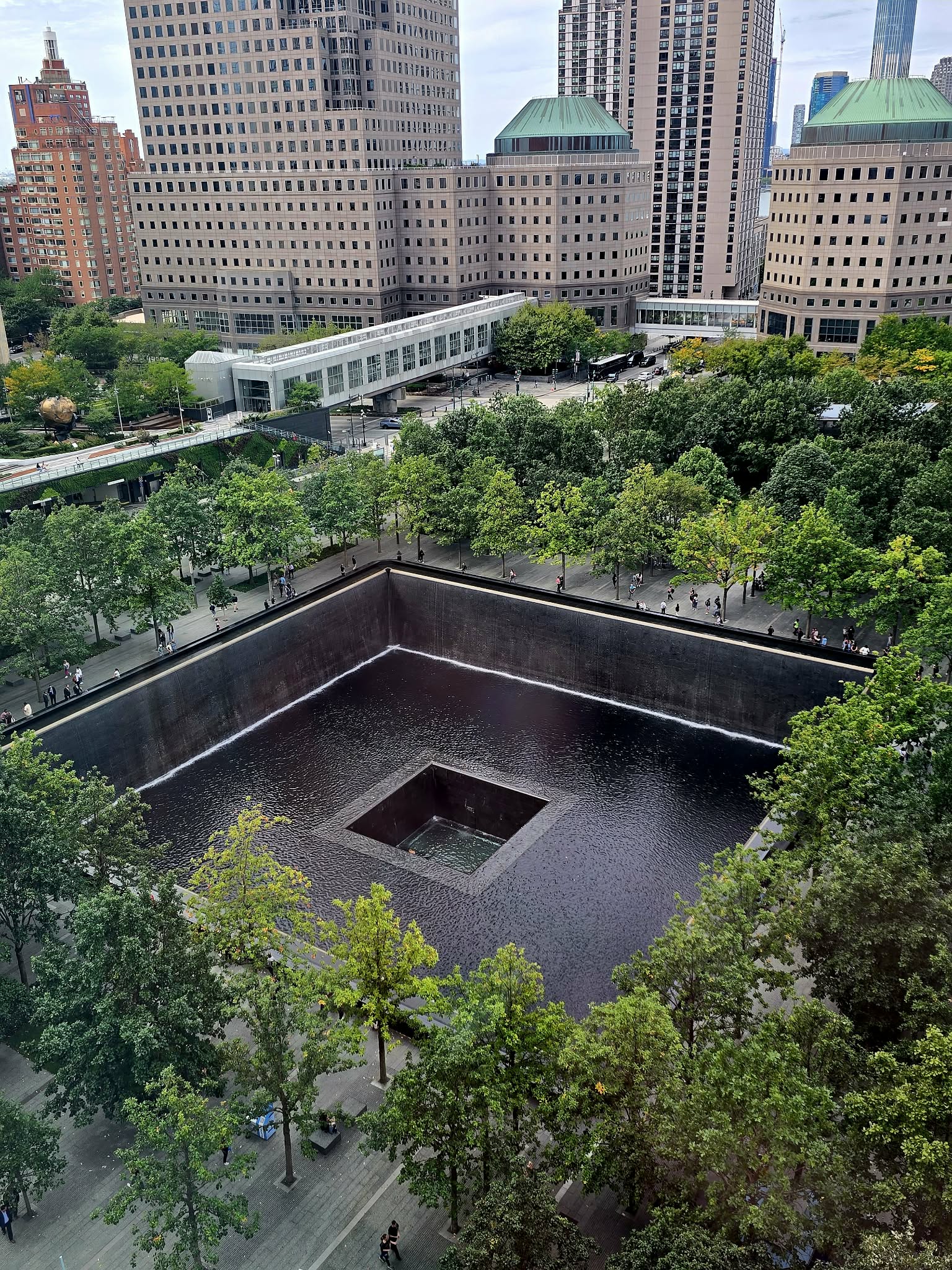
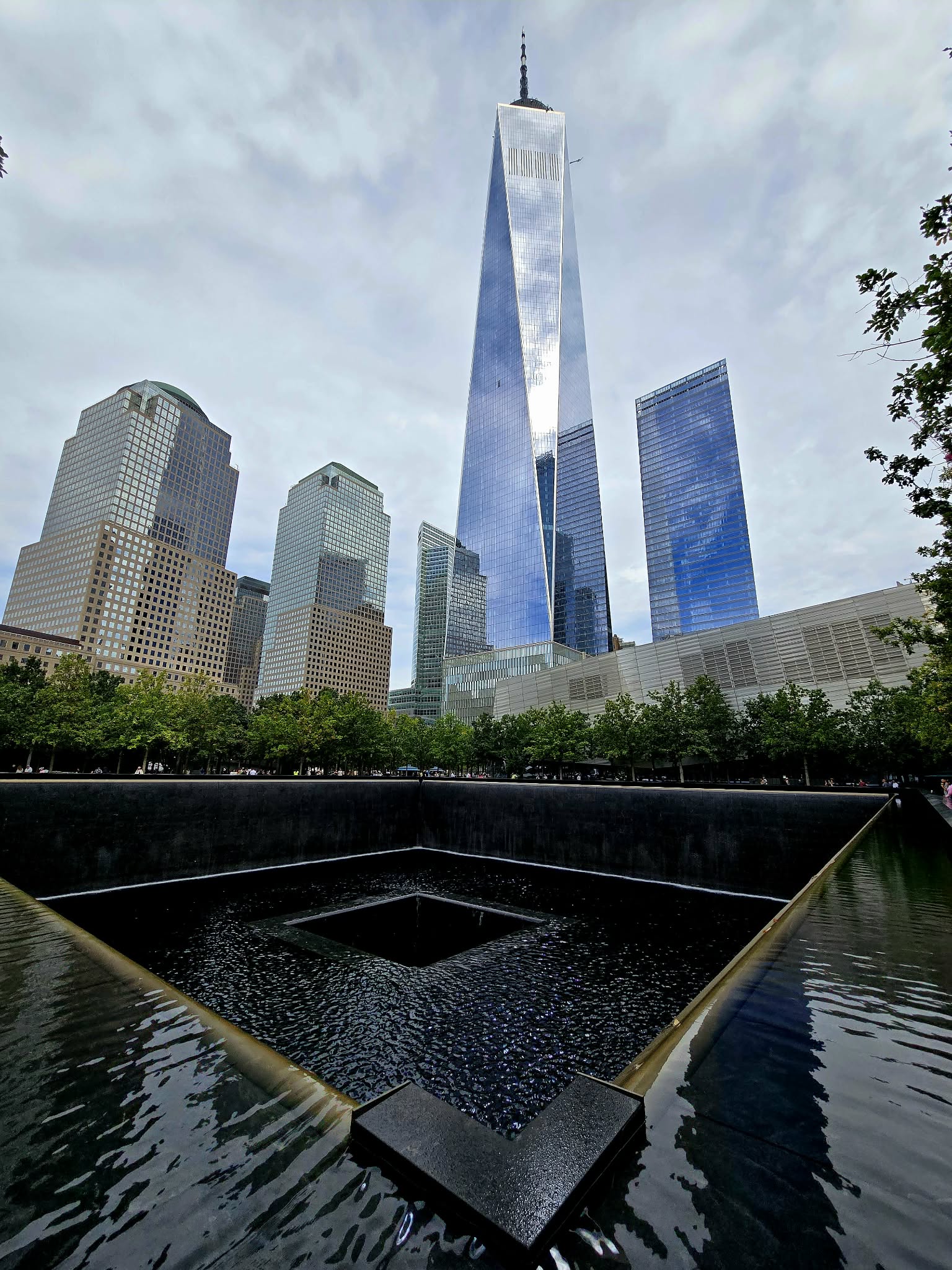
On Sunday, August 23, hundreds of riders took part in the final leg to the National September 11 Memorial. After days of rain, wind, police escorts, highway miles and communities standing beside roads, the motorcycles finally reached the place toward which the entire journey had been moving.
Eventually the engines stopped and the helmets came off. What can be described are the names waiting there. The names inscribed at the National September 11 Memorial aren’t statistics. Each belonged to someone, to a family, friend, coworker and a community. Every September 11, family members read those names aloud one at a time.
For those of us who did not lose someone that morning, a quarter century can gradually transform September 11 into history. For the families who did, it remains personal: a photograph, a remembered voice, a birthday that continues arriving, a story told to grandchildren, or a hand placed over a name engraved in bronze.
“Never Forget” asks us not simply to remember what happened, but who was lost.
The National September 11 Memorial & Museum preserves the history of the attacks while honoring the victims, survivors, first responders and others affected by September 11. Readers who want to learn more about the Memorial and Museum, its educational resources and continuing remembrance can visit:
National September 11 Memorial & Museum
The Human Toll Did Not End on September 11
In the days, weeks and months that followed September 11, rescue and recovery workers, firefighters, police officers, EMTs, construction workers, volunteers and others worked at Ground Zero and the other attack sites. Survivors and members of surrounding communities were also exposed to the aftermath.
Alongside them were hundreds of working dogs and their handlers who searched debris, helped locate survivors and remains, provided security and offered comfort during unimaginable circumstances. The dogs could not understand the enormity of September 11, but they answered the call beside their human partners, and their service deserves to be remembered, too.
For many people exposed to the aftermath, serious health conditions emerged years later. Some have died from illnesses associated with their service or exposure, while thousands of others continue living with 9/11-related health conditions. They, too, are part of the continuing human cost of September 11 and another reason remembrance cannot be confined to the people who died that morning.
Remembering Through Action
Ted is clear about the Foundation’s purpose: support first responders and honor those who lost their lives. The ride is also a primary fundraiser supporting that mission. According to Ted, the Foundation has awarded more than 366 college scholarships totaling nearly $700,000.
“And that’s just from a motorcycle ride,” he told Powersports Business.
The Foundation has also given away 25 Harley-Davidson police motorcycles to law-enforcement departments that help escort the ride, with Ted explaining that the Foundation purchased nearly all of them. The impact therefore doesn’t end when the engines shut down in New York. Money raised by motorcyclists helps members of first-responder families pursue an education, while motorcycles provided by the Foundation return to communities and continue serving.
That may be one of the most meaningful answers to the question of how we should remember something terrible. The Foundation doesn’t simply ask people to look backward, it uses remembrance to do something useful in the present.
What “Never Forget” Means 25 Years Later
Twenty-five years creates a challenge that wasn’t present when Ted and Lisa first rode to New York in November 2001. Millions of Americans alive today have no personal memory of September 11 because they were too young or simply hadn’t been born. Many young firefighters, police officers, EMTs and motorcyclists know that morning only through what others have taught them.
“Never Forget” therefore can no longer mean only remembering something we personally witnessed. Memory has to be passed from one generation to another.
Sometimes that happens in classrooms, museums and memorials. Sometimes it happens when a child stands beside a road and watches hundreds of motorcycles pass beneath an American flag. The child asks a parent why the motorcycles are there, why firefighters are saluting or why people are waving flags, and a conversation begins.
We cannot give younger generations our memories, but we can give them the stories behind them. We can explain why people helped strangers, why first responders ran toward danger, why communities came together and why those lessons still matter.
Why They Still Ride
Near the end of his conversation with Powersports Business, Ted was asked whether the 25th anniversary might represent a conclusion. His answer was firm: the ride will continue.
That matters because the people who personally remember September 11 will not always be here to tell the story. The Foundation, riders, first responders and communities along this route have created something capable of helping carry those memories forward.
I wish I could describe the 2026 America’s 9/11 Ride through my own windscreen. I wish I could tell Rider readers what it felt like to leave Somerset near the front of the procession, ride through hours of rain, see communities come outside to greet us, stand quietly at the Pentagon, cross highways cleared by police motor officers, enter New York and finally shut off the engine near the World Trade Center site. I can’t, and I won’t pretend that I can.
What I can do is listen to Ted and Lisa Sjurseth and the people who have made this journey. I can learn from the motorcyclists who ride it, the police officers who escort it, the first responders and volunteers who support it, the communities along the way and the reporters who documented this year’s procession. Most importantly, I can remember why they were there.
The 2,977 people whose lives were taken on September 11 deserve to be remembered as far more than a number in a history book. They were people who went to work and never came home, passengers and crew members who boarded airplanes, first responders who answered calls for help, and ordinary people confronted with circumstances none could have imagined that morning. We must also remember the people who loved them and have spent a quarter century carrying their memories. They are why “Never Forget” matters.
Ted and Lisa Sjurseth could not have known what they were beginning when a planned motorcycle vacation became a 25-degree ride from Washington, D.C. to New York in November 2001. They simply knew they needed to do something.
America’s 9/11 Ride doesn’t simply take motorcyclists to three memorials. For hundreds of miles, the ride itself becomes one. A moving tribute to those who never came home, those who still carry them, those who answered the call, and the generations who must now carry their stories forward.
Ted told Powersports Business, “If you’re a biker and you wanna see America and what America remembers from this, you need to come.”
For motorcyclists who want to learn more about America’s 9/11 Ride, the Foundation’s history, its programs or participating in a future ride:
After learning what happens along those hundreds of miles, I understand what Ted means. You don’t have to personally know one of the 2,977 people who were killed to remember them. You don’t have to wear a badge to appreciate those who answered the call, and you don’t have to ride a motorcycle to stand beside the road. You also don’t need to do something extraordinary to help keep someone’s memory alive.
Sometimes you simply have to show up, listen, remember, and make sure the person standing beside you understands why it still matters.
That is why they still ride.
Never Forget.