
Watching Ducati win its sixth consecutive MotoGP constructor’s championship in 2025 jogged some memories for this veteran fan. My history with the Italian marque has been long and mostly satisfying, the length spanning more than 60 years and the satisfaction factor ranking well above their minor annoyances. At least ten Bolognese bikes have been in my garage over the years. Herein are some of my favorites and a few others that I find worthy of retrospection.
Ducati had shifted from electronics to motorcycles in 1946. Since I had been produced just five years earlier, my early riding years coincided with the first Italian Singles to arrive in U.S. dealerships. By the mid-’60s, Honda and Yamaha had begun to match the British marques in nationwide dealers. But the smaller European companies – Ducati, Bultaco, Montesa, Husqvarna, and CZ – were gaining footholds in multibrand shops.
My friend Tom Simmons was working as a mechanic at a Saab dealership in Akron, Ohio. Given the mid-’60s boom in motorcycle sales, the owner added Suzuki and Ducati to the showroom. And Marusho! We figured that profit wasn’t his primary motivation. He just dug motorcycles. That said, markup for dealers in those days was 25-30%. Nowadays the average is closer to 5%. And there are notably fewer motorcycle shops.
Tom and I were bedazzled by the Suzuki X6 Hustler and all but enchanted by the Ducati Diana 250 Mark 3. It should be noted that our respective roadbikes at the time were a BMW R69S and an Ariel Square Four. Small bikes were something of a revelation. And the design and execution of the Ducati must have awakened some gene tuned to the artistic side of industrial design, a hereditary appeal to our instinctual joy in things that look cool and go fast.
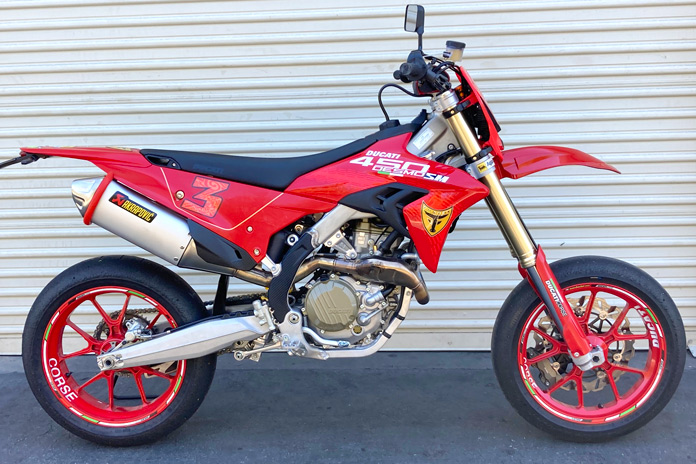
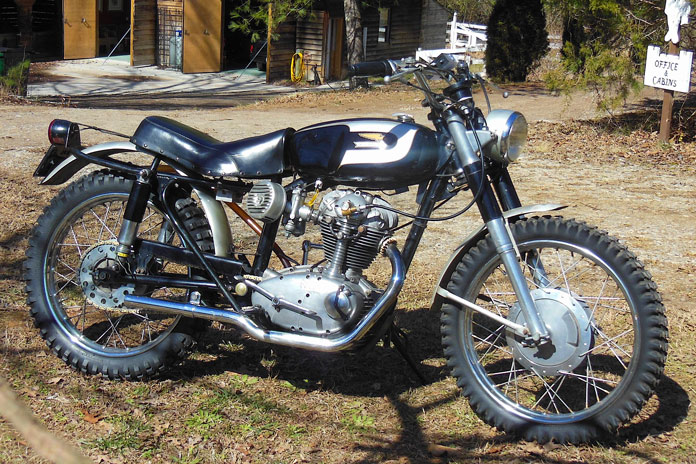
So that led me to a Ducati 250 Scrambler, gem of a little thing and cute as a bug but one that revealed the first pinch of irritation. The rebuild seemed fairly basic and straightforward: piston in position, timing marks on the cam gears lined up, ignition set to specs, and… nothing. Nothing but a series of snorts and backfires.
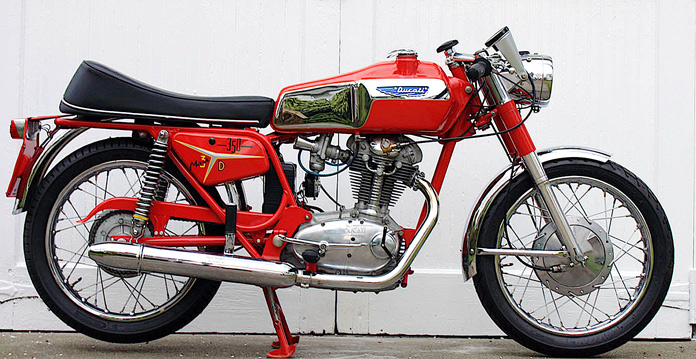
I came to discover that the valve timing, while appearing to be properly aligned, can be 180 degrees out of phase. With that sorted, the Scrambler ran and handled well as a streetbike. It was easily re-jigged for flat track, but the 2-strokes had come to dominate scrambles and enduros by then and were fixing to do the same in motocross. I opted for a Bultaco 175 Sherpa S.
At this point, in 1966, I accepted the U.S. Army’s invitation for a two-year paid vacation, which unfortunately included no motorcycles. Following a mostly honorable discharge, I scraped together enough to buy a lightly used BSA 650 Lightning, followed by a 1967 500cc Velocette Thruxton, to this day the smoothest big Single ever. And to my eyes, on the same aesthetic plane as a Ducati for architectural style and grace. Then came a four-year stint at Cycle News, with an endless stream of new motorcycles to test ride. I imagined it was what heaven must be like.
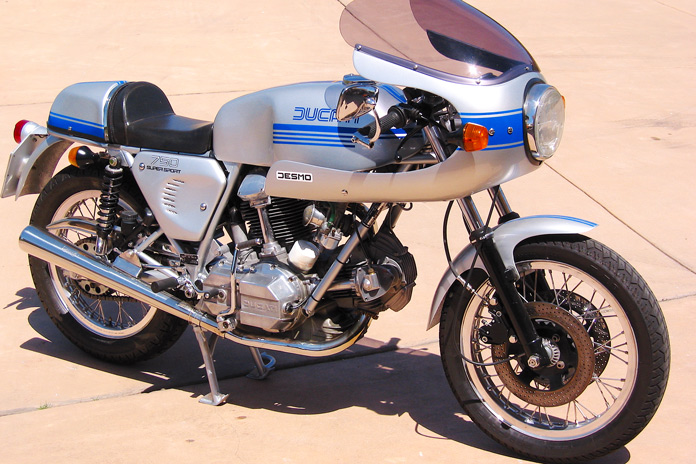
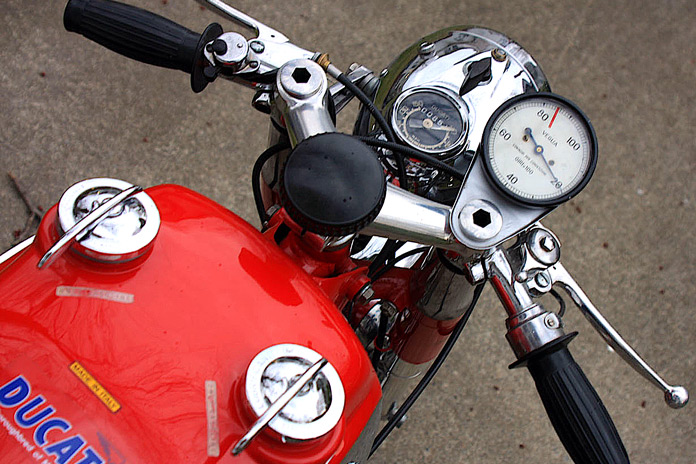
In the early ’70s my garage hosted a Honda SL350, a Bultaco 250 Pursang, and a Yamaha RD350 in that order, but nary a Ducati. Then relocating to California, the Bologna jones reawoke, and I was found by a spunky little Diana 350. The ’68 model was distinguished by dual gas caps, for no apparent reason other than symmetry, and a firmly Italian bench seat. As an urban scratcher around Marin County and later the SoCal canyons, the 350 was a holler and hoot. But little did I know, in 1974, that waiting in the wings was the new Ducati 750 Sport, calling me long-distance from Ohio.
See all of Rider‘s Ducati news and reviews
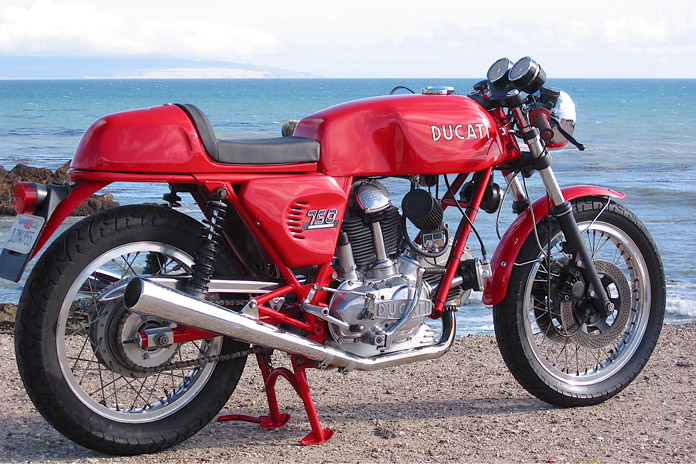
On a visit to my folks, I stopped by Portage Cycle in Ravenna, Ohio, the shop of my college years down the road at Kent State. And there she was… sparkling in school-bus yellow livery and no superfluous graphic frippery. I was admittedly smitten, but it was their first and only one and had already been bought by Terry, the shop’s salesman. He assured me another one was on the way and that I was welcome to take his for a demo ride. I gladly accepted.
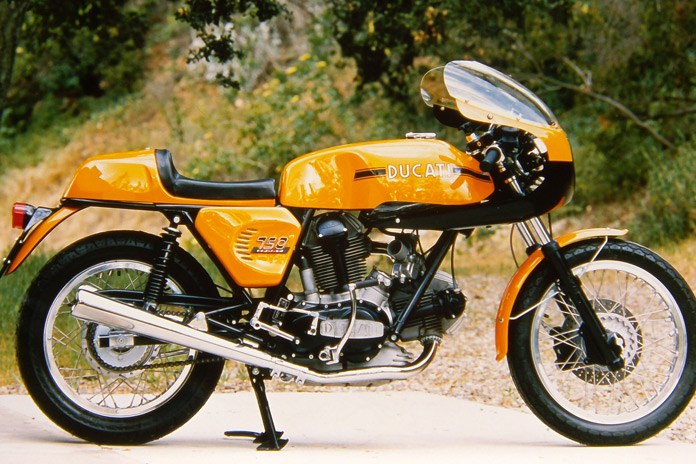
Within a few miles on the country roads, I was a born-again Ducatista. Glorioski! The delicious thrust of smooth V-Twin power, the confident handling at speed, even the single front disc/rear drum brakes worked seamlessly. Magical. I rode back to the shop, grinning like an idiot. Okay, how much? $2,345. Sold. Call me when it comes in.
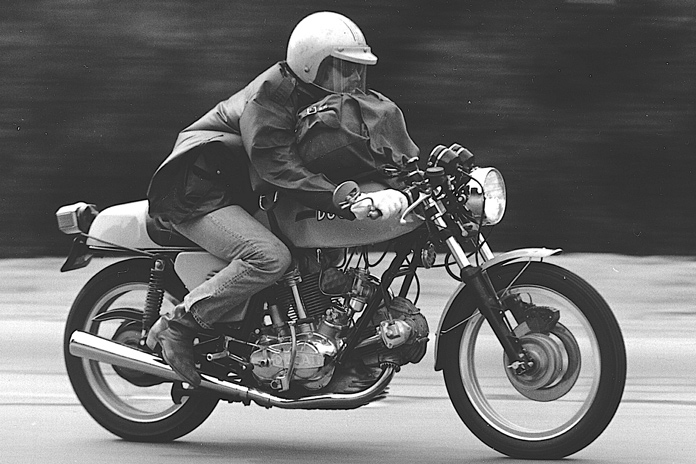
Two weeks later I was on the road to California, my gear in a duffel bag strapped to the tank. The thought of riding cross-country with clip-on bars and rear-set footpegs was untenable, and the bag made a good pillow. (Not for napping, just to rest the neck and wrists.) My circuitous route came to just over 3,000 miles, with most days in the 250- to 300-mile range. The last day, keen to get home, I logged nearly 600, but it was exhausting, even for a fit pup of 33.
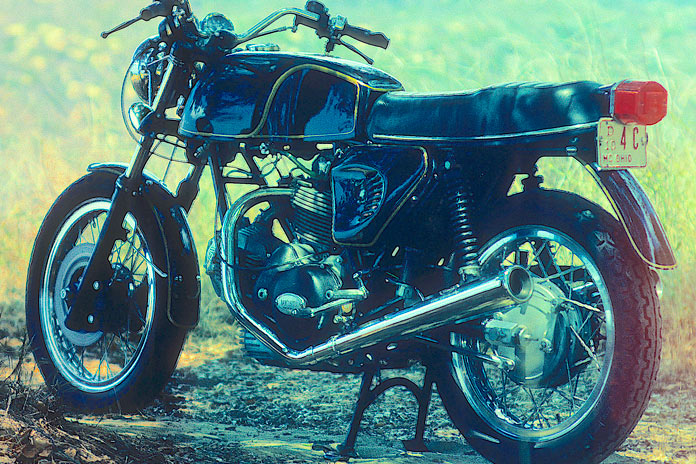
The story of that ride appeared in the May 1975 issue of Cycle Guide magazine. Over the next 50 years, several more Ducatis would follow, but none offered more pure fun in the saddle than the 750 Sport. In fact it was followed by another Sport after I bent the first one up on Topanga Canyon Boulevard. This one had come from Canada and was identical but for the fiberglass tank. That party lasted a few more years, during which the Sport was amended as a two-up roadster, with a Norton-esque black and gold paint job, flat-track handlebars, and a Suzuki 550GT seat. More suitable for the new father and responsible job-holder I’d become.
In the mid-’70s I managed the sole gas station in Topanga Canyon, and the Sport sat next to it. The then-rustic hamlet was flush with artists and celebrities who came through to gas up. Billy Preston was a regular in his Jeep, speedway racers Sonny Nutter and Billy Gray lived in the hood, the elder Carradine brothers came by, and numerous famous or soon-to-be-so musicians and actors were just neighbors with familiar faces.
My fondest memory is the day I had the Sport at the pumps and a fellow in overalls, a T-shirt, and sandals ambled up. “Have we met somewhere?” he said. We hadn’t, but I recognized him immediately as Lowell George, head of my favorite local band, Little Feat. “No,” I replied, “we haven’t met but I am a fan of your music.” He said thanks, seeming a bit shy for a rock ‘n’ roller, and said, “That’s a really nice bike,” and I had to agree. We talked a bit about the bike, and he headed back across the street to the post office. Perhaps to see if there was some “long distance love” from his touring girlfriend Linda Ronstadt.
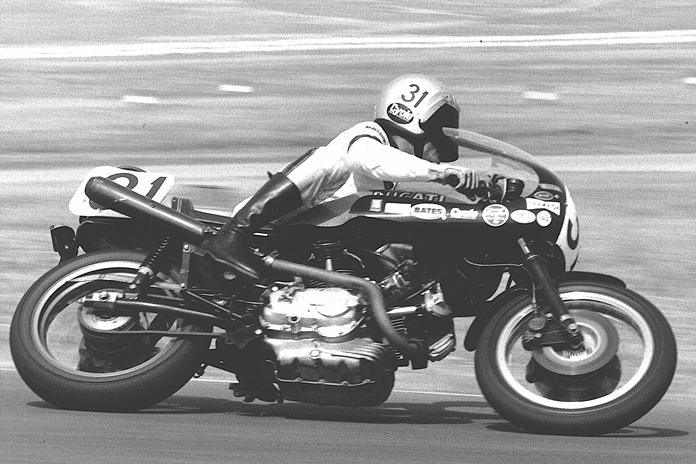
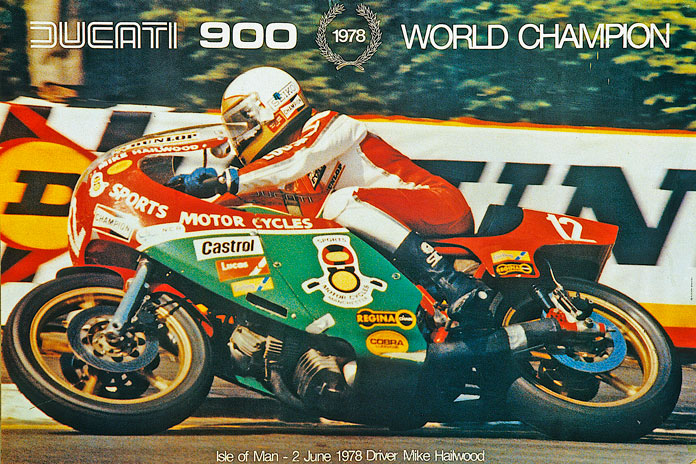
In those days, Cycle magazine’s Cook Neilson and Phil Schilling had been touting Ducati’s engineering for a few years, since Paul Smart’s 1972 win on the 750 at Imola. When they won the 1977 Daytona Superbike race, more than a few American sport riders gave the brand another look. With Norton, heretofore the best handling British bike available, now consigned to history, Ducati was ready to fill the gap. And it did. Mike Hailwood’s Isle of Man victory in ’78 signed, sealed, and certified the factory’s credentials as world class.
The Sport and I left Topanga in ’78 to take a job with Vetter Fairings in San Luis Obispo, California. It was a good gig but short-lived when Craig Vetter soon decided to sell the company and set up his design studio in Carmel Valley. So it was back to freelance motojournalism, supplemented by a day job as a golf course greenskeeper. But the Sport had to go, as motocross and trail riding had grabbed my attention and bank account.
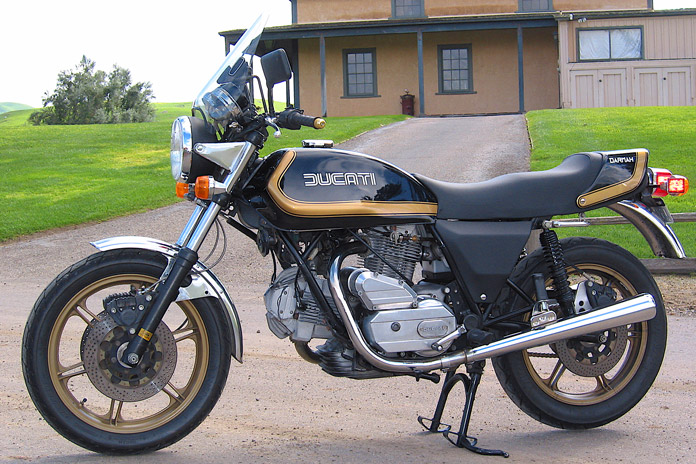
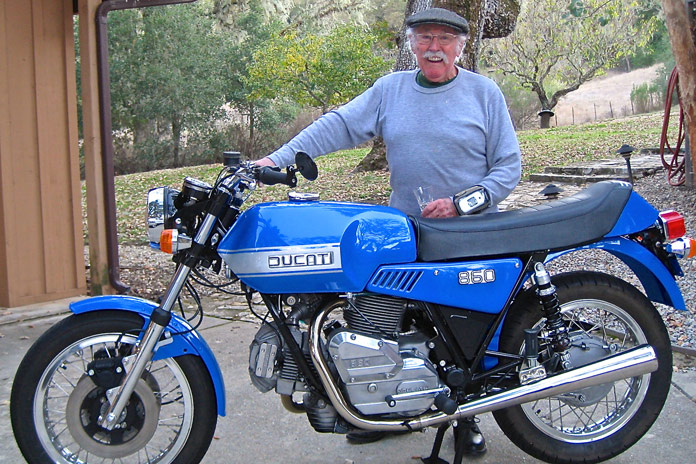
But a few years later the Italian itch returned, and the scratch was a 1981 Darmah 900 SD, which would become my favorite Ducati for grown-ups. A true gentleman’s express of the first order, and a roadster of uncommon acuity, comfort, and style. The Darmah evolved from the 860 GT series of the mid-’70s, which wore the angular styling of car designer Giorgetto Giugiaro, and found little popularity in America. Styled by Leo Tartarini, the Darmah SD and sportier SS series had more success and a seven-year production run.
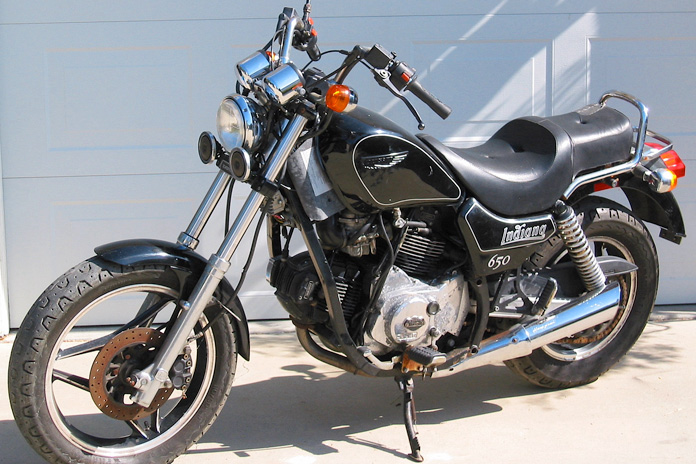
But then, nearly 40 years on, the Ducati bevel-drive era was winding down, replaced for mostly economic reasons by belt-drive cams but retaining their signature desmo valve train. Under Cagiva ownership in the ’80s, while racing and sportbikes remained the marque’s trademark, production of enduro models grew apace. Bologna even offered a nod to the U.S. market with the cruiser-style Indiana, which was widely and justifiably ignored.
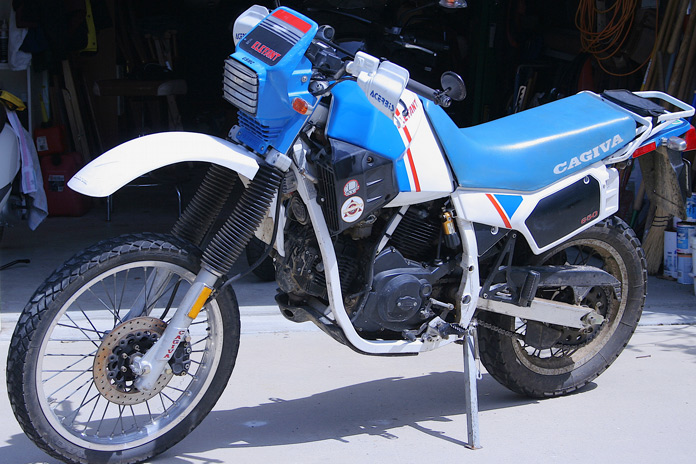
More engaging to me was the Cagiva Elefant, derived from the factory effort to win the prestigious Paris-Dakar race, which they achieved with rider Edi Orioli in 1990 on a 900cc Elefant. The dual-sport models, with 650cc, 750cc, and later 900cc engines, were built to compete with BMW’s R 80 G/S, the progenitor of today’s adventure-tourers. The ’86 Elefant 650 was a stout, but rather heavy, dual-sport device capable of gratifying speeds on jeep trails and fire roads. It was also reasonably compatible on long highway rides. The later 900E (fuel-injected) and Gran Canyon models were more pavement oriented but still off-roadable. Both were still stylish in the Italian manner and set the pattern for similar models to follow from Yamaha and Honda.
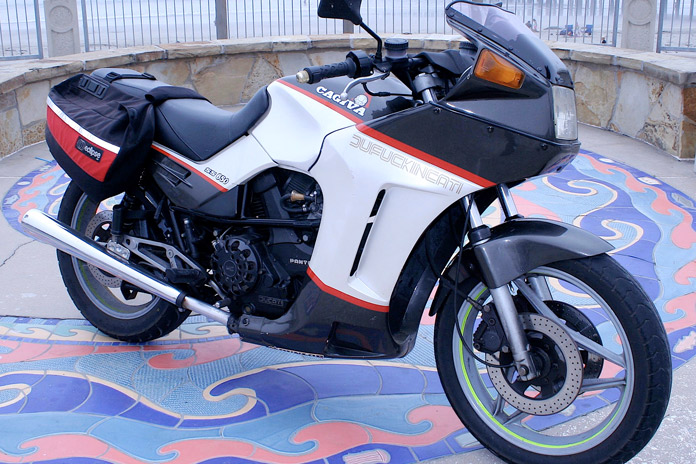
Having satisfied my need for the backcountry boogie, the Elefant gave way to its road model sister, the Alazzurra 650 SS. And enamored as I was with the ’Fant in the dirt, I was equally jazzed by the road smarts of the Alazzurra (Blue Wing in Italian). With 55 hp and weighing little more than 400 lb, it was sufficiently quick and turned, stopped, and looked swell. The chassis and engine layout was derived from the Pantah 600/650 series, a design later refined in Japan with fuel injection, liquid cooling, and more power in Suzuki’s SV650.
I rode the stink out of that bike and enjoyed it immensely. And while it had to go for something more utilitarian (a Honda Nighthawk 650), I soon got another one. An identical model, the next Alazzurra was Marty Dickerson’s last bike. Then in his mid-80s, the Vincent maven had sold his 1975 860 GT and his Monster 900 City. “I was getting ready to put the Alazzurra back on the road,” he said. “But then the family persuaded me it was time to stop.”
The Ducati/Cagiva bromance ultimately dissolved, but it created the groundwork for the most successful model yet. The collaboration between engineer Massimo Bordi and designer Miguel Galluzzi brought forth the Monster, which saved Bologna’s salami and put Ducati in the big leagues again. It also financed further development of the SS sportbikes, the Superbike racers, the Multistrada, MotoGP, etc. In the early 2000s, the Monster accounted for 53% of Ducati sales.
In 1998 I was contracted to do a book on Ducati history, which meant I quickly blew the advance on a trip to Italy, just in time for the first World Ducati Week in Bologna and Rimini. During the factory tour I interviewed designer Pierre Terblanche in the company cafeteria, where he bought me a beer. How civilized, I thought. Patriarch Fabio Taglioni, Dr. T himself, then 78, was on hand at Misano for the celebration. A hundred or so Ducati Twins from all over Europe honored him with a full-throttle ovation. He was visibly moved.
I felt the book, Ducati, covered the story fairly well, with an American slant, owing much to the excellent photos from Tom Riles, Guy Webster, Nick Cedar, and Bill McMillan. A sour taste arrived with a later charge of plagiarizing Ducati historian Alan Cathcart’s account of Mike Hailwood’s return to the Isle of Man. I had used Alan’s piece as a reference and duly listed it in the bibliography, which the publisher omitted from the book. Bygones, though it did rankle for a while, and I later clarified things with Alan.
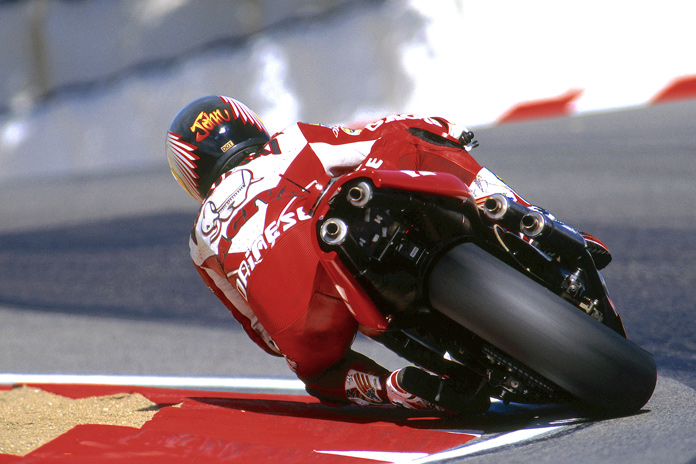
By then Ducati had come to dominate World Superbike racing, with Doug Polen and Eraldo Ferracci winning in 1991-92 and Carl Fogarty taking his fourth title in 1999. Ben Bostrom and Anthony Gobert upheld the Bologna banner in the American Superbike series that year, though the title went to Suzuki’s Mat Mladin. Major credits are also due to Reno Leoni and Jimmy Adamo, as well as the Troys of Oz, Corser and Bayliss, for flying the Italian flag in the USA. And the privateers Paul Ritter and Jonathan White likewise deserve credit. With the turn of the century, the factory’s emphasis shifted to MotoGP, and it took its first title in 2007 with the remarkable Australian rider Casey Stoner.
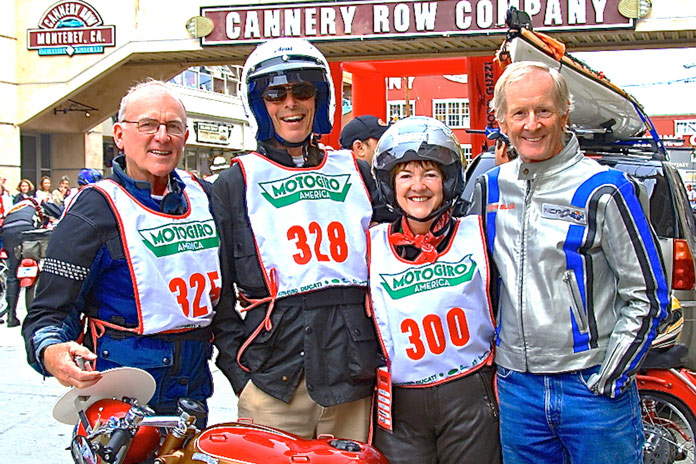
Ducati celebrated its worldwide success in 2008 with the Motogiro America in north/central California. The five-day vintage event, starting and ending in Monterey, included Highway 1 through Big Sur, through the Paso Robles wine country and back. Among the prominent Ducatisti were Paul Smart, Cook Neilson, Phil Schilling, and unofficial brand ambassador Vicki Smith. Moto Guzzi, the honorable competition, was represented by vintage racer Dave Roper on a 1951 250cc Airone. A damn fine time was had by all.
Ownership of Ducati in the past quarter-century has bounced around between investment firms, banks, and industrial collectives. Now, under the Audi/VW umbrella, the company maintains its fundamental commitment to racing, high-performance sportbikes, adventure touring, muscle cruisers, and, recently, motocross, indicating that lightweight enduro models are not far behind. Perhaps another Supermono?
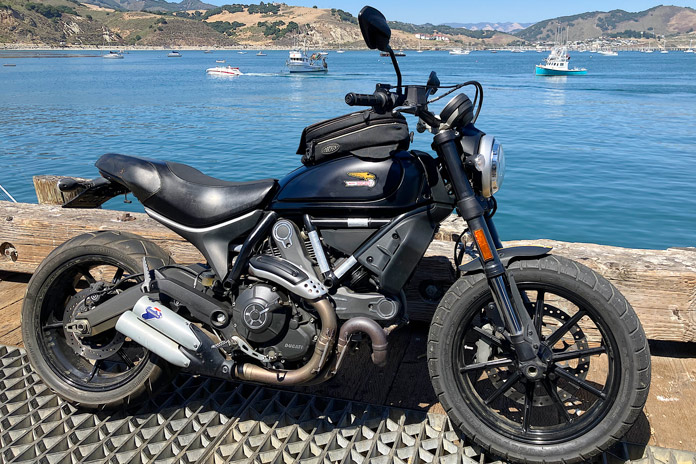
For my own riding needs, the 800 Scrambler may be my last Ducati, and at 85, likely my final roadbike. It’s fast enough, it’s cute enough, and doggone it, I like it. My feet are planted at stops, it’s got ABS, I have no worries about coolant leaks, and it cruises comfortably at 70 mph. The Scrambler has the bones of the Alazzurra, a bit of the Elefant in its blood, and a portion of the Monster in its attitude. I’m clam happy, Sam I am.
Each of these Ducs has provided me moments of chortling joy, interludes of calm spirit, and on occasion, lucid comprehension of the natural world. And a few seconds here and there of absolute terror. I value the memories of each. Now, the charms of the Panigale V4 are beyond both my budget and interest. I’m too old for spiking adrenaline, hanging off, and strafing apexes. In fact, I’ve promised my lovely wife that the Scrambler will be the last one, and she didn’t ask me to sign a note and have it notarized.
So I raise a toast to Ducati Meccanicca, the racing team, and champion Marc Márquez. Bravo! Tutto Bene! May you carry on for another 80 years. And mille grazie for the memories.
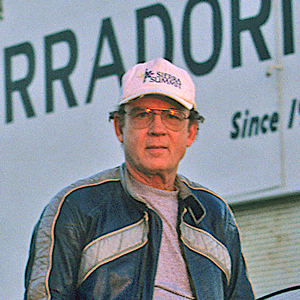
T.J. Rafferty served as editor of Cycle News and Big Bike and has contributed to numerous magazines, including Rider and American Rider. He has authored The Encyclopedia of American Motorcycles and books on Harley-Davidson, Indian, and Ducati.

What a wonderful article. Thanks for writing and publishing it. ****** Years ago I stopped in the Daytona pits and briefly chatted with Schilling and Nielsen. They were both really nice guys and gentlemen of the first order. I feel fortunate that I lived during the period when guys like Schilling and Nielsen were into motorcycles. What they brought to the motorcycle scene was the sort of stuff we are not going to see again. Salute to them !
Thanks. Indeed, Phil and Cook’s skill sets were uncommonly well-matched, and Cycle magazine was the high water mark in American motojournalism. They set a high standard, and of course boosted Ducati’s image immeasurably. I agree, for riders and readers, they were the best of times.